
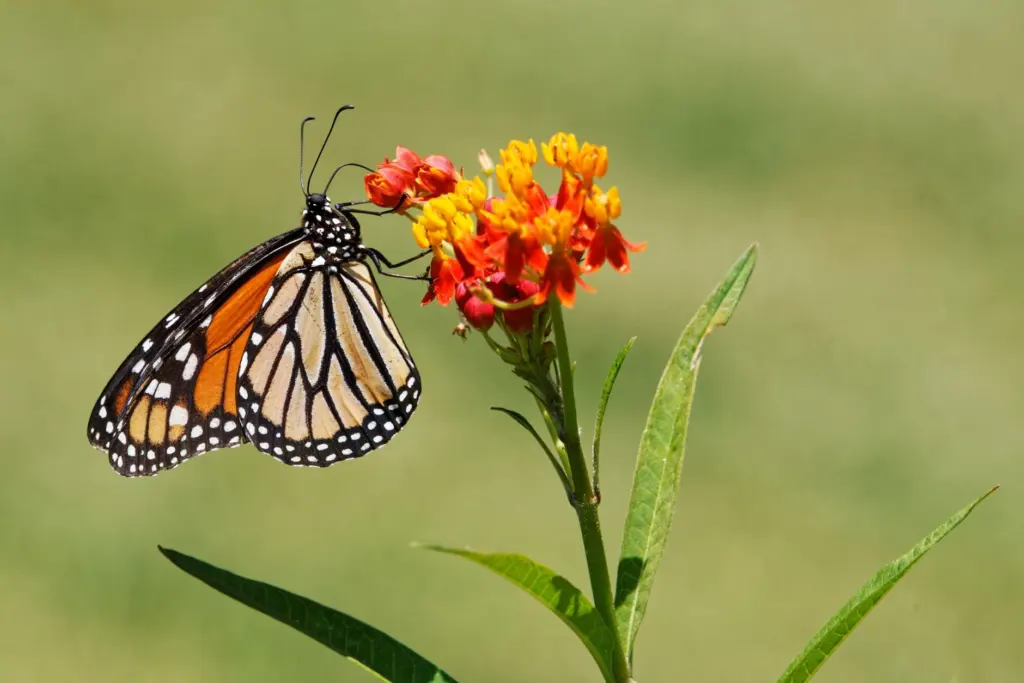
The life cycle of a monarch butterfly has four stages: egg, caterpillar, chrysalis and adult. Development from egg to adult takes about 30 days, but the migratory adult generation lives for months.
The stages run in a fixed order, and the timing of each one decides how many generations fit into a year. Readers who want to turn this kind of observation into a proper investigation can pair this guide with scientific method steps explained in the science hub.
Metamorphosis and the four stages
Butterflies undergo complete metamorphosis. Each one begins as an egg, passes through a distinct larval stage, becomes a pupa and ends as an adult, according to the University of South Florida’s butterfly atlas. The same source defines a generation as one full four-stage cycle. That definition matters for monarchs, because one generation hands the cycle to the next until the final generation of the year changes the pattern.
The table gives the working timeline for the monarch. Two of the ranges differ by source, so both are shown.
| Stage | Typical duration | What happens | Planning use |
|---|---|---|---|
| Egg | About 4 days | A female lays the egg on the underside of a milkweed leaf. | The shortest stage, so a caterpillar appears quickly after laying. |
| Caterpillar (larva) | 10-14 days, across five instars | The larva eats only milkweed and grows through five instars. | Milkweed has to last the whole stage. |
| Chrysalis (pupa) | 8-12 days (NDSU); 10-14 days (Monarch Watch) | The larva transforms into the adult inside the chrysalis. | Plan for the wider span of 8-14 days. |
| Adult, spring and summer | Two to five weeks | The adult feeds, mates and lays eggs. | Several short-lived generations follow one another. |
| Adult, migratory generation | On average 6-9 months | The adult flies to overwintering sites. | This is the generation that bridges the winter. |
Figures are drawn from the NDSU Extension monarch life cycle publication and Monarch Watch’s monarch biology page.
These ranges are guides, not fixed schedules. Treat the shorter and longer ends as the normal spread, not as a target.
Egg: the first four days
A monarch begins as an egg that a female lays on the underside of a milkweed leaf, as NDSU Extension describes. Monarch Watch reports that the eggs hatch about four days after they are laid and that each egg is 1.2 mm high and 0.9 mm wide. A University of Houston outreach page gives a hatch window of 3-5 days, so a few days either side of four is normal.
The choice of leaf is not incidental. Monarch larvae eat only milkweed and will not grow to adulthood on any other plant. A female that lays elsewhere gives her offspring nothing to eat.
Caterpillar: five instars on milkweed
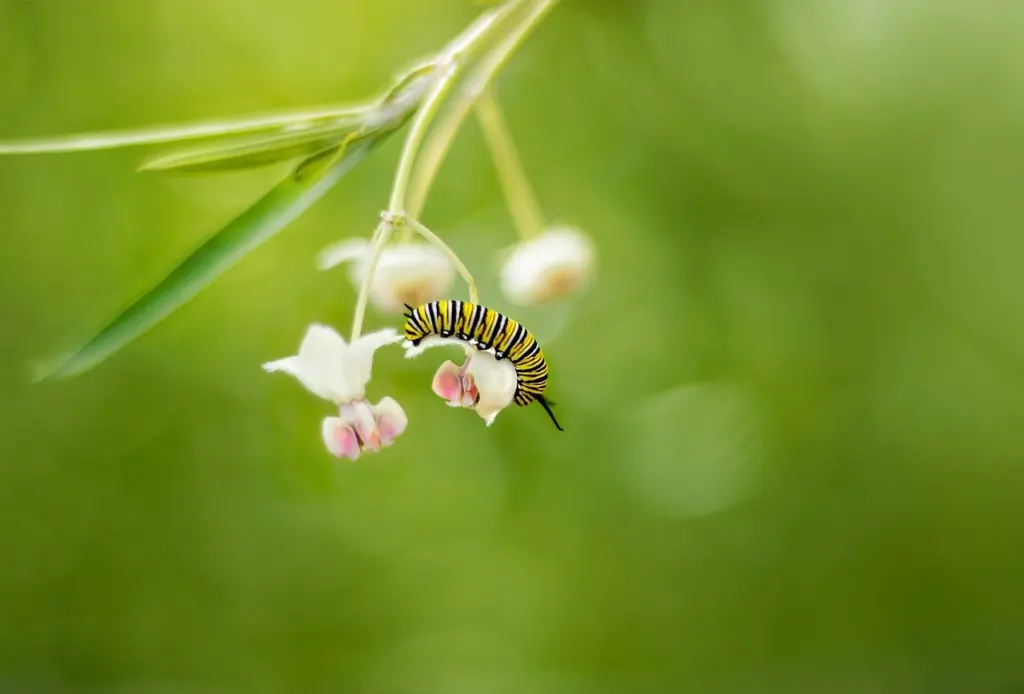
The caterpillar sheds its skin repeatedly, and each period between molts is called an instar, so the larva passes through five instars, according to NDSU Extension. The same publication notes that the larvae eat only milkweed, a plant that carries toxins called cardenolides.
Growth in this stage is steep. Monarch Watch lists approximate body lengths for each instar:
- First instar: 2-6 mm, barely larger than the egg it came from.
- Second instar: 6-9 mm.
- Third instar: 10-14 mm.
- Fourth instar: 13-25 mm.
- Fifth instar: 25-45 mm, the full size reached before pupation.
These lengths are a practical identification aid. A caterpillar of 6-9mm is in the second instar, not the fifth, so length tells an observer roughly how much of the stage remains.
Chrysalis: where the transformation finishes
Once a late fifth-instar larva has reached sufficient body mass, it pupates. During the pupal stage, Monarch Watch explains, the transformation from larva to adult is completed. This is the metamorphosis itself: the caterpillar’s body is reorganised into the winged adult.
The pupal casing of a butterfly is called a chrysalis, and it is not a cocoon. NDSU Extension states that cocoons are unique to moths. NDSU gives the stage as 8-12 days, while Monarch Watch gives 10-14 days. Anyone watching a chrysalis should expect the adult to emerge somewhere in the overlap of those ranges, and should not worry if it takes the longer span.
Adult monarchs: lifespan by generation
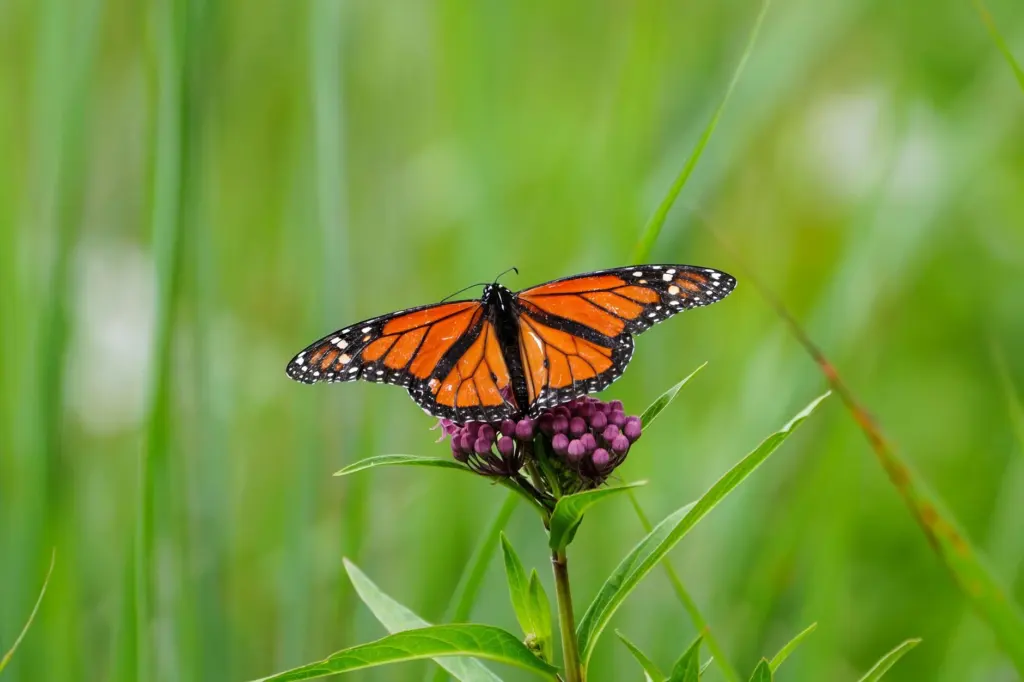
Adult lifespan is the point where monarchs differ most from a generic butterfly. Adults that emerge in spring and summer typically live two to five weeks. The final generation, which emerges in late summer and early fall, has an additional job: migrating to overwintering sites. Those adults are the migratory generation and live on average 6-9 months. Monarch Watch says these adults can live up to eight or nine months, so that figure is a ceiling, not an average.
A short summer life and a months-long migratory life belong to the same species. The difference is the generation’s role. Summer adults reproduce quickly, while the migratory generation carries the population through the winter.
Migration across generations
Monarch migration is spread across several generations, not one long journey by a single insect. In the eastern population, taking three to four generations completes the annual migration from the overwintering grounds and back. The overwintering grounds are in the Sierra Madre Mountains in Mexico. Only the final generation of the year makes the southbound trip.
These adults fly up to 3,000 miles, at a pace of 25-30 miles per day, according to NDSU Extension. The distance is an upper bound for the longest flights, and the daily pace is the typical rate rather than a guaranteed speed. The University of Houston outreach summary describes the overwintering generation as the one that spends the winter in Mexico and lives for eight months. That fits the average of 6-9 months for the migratory generation.
The reason for the journey follows from the generation structure. The final generation’s job is to reach overwintering sites and live there, which is why its adults live months while summer adults live weeks. The Western Monarch Milkweed Mapper describes the same pattern for western monarchs, with the final fall generation migrating to overwintering sites and living for 6-9 months.
Observing monarchs at home or in class
The table above works as a ready-made observation log. Record the date a stage begins and compare it with the ranges. A caterpillar that has been eating for about two weeks is close to pupation, and a chrysalis that has hung for more than a week is close to emerging. Only milkweed will keep a caterpillar growing, so the food supply sets the limit on any classroom project.
A monarch log is one of the simplest repeated-measurement projects a class can run. For other hands-on ideas, see 3 Easy Science Experiments To Try At Home (Safe, Fun, And Kid-Friendly) – Ricecatalyst. Another topic that rewards a step-by-step reading is Inside Earth’s Mechanics: A Clear Guide To The Mechanical Layers Of The Earth (2026) – Ricecatalyst.
Frequently asked questions
How many eggs does one female monarch lay?
Females lay an average of 300-400 eggs, according to NDSU Extension.
Does temperature change how long the cycle takes?
Yes. For western monarchs, the Western Monarch Milkweed Mapper says a full cycle may last 20 to 35 days, sometimes longer, depending on temperature.
What do adult monarchs eat?
Nectar provides most of the adult diet. Monarch Watch notes that flower nectar is about 20% sugar.
How soon can a new adult breed?
Adults reach sexual maturity in 3-8 days, according to the Western Monarch Milkweed Mapper.