
A child asks, “Is a food chain just a list of animals?” Not quite. The best food chain examples for kids usually start with a green plant and use arrows to show energy moving from the sun to each eater.
The activities below rely on careful looking and recording. For the habit behind that, see scientific method steps explained.
What a food chain shows
A food chain is a list of organisms in a habitat that shows what eats what, according to BBC Bitesize. The organisms are joined by arrows, and the arrows show the transfer of energy in food from one organism to the next. The initial source of energy for every food chain is the sun.
Most chains begin with a green plant, because plants make their own food by photosynthesis. A plant that makes its own food is a producer. The animals further along the chain are consumers. BBC Bitesize gives a simple case: grass is the producer, and the animals that follow it (grasshopper, frog, hawk) are consumers.
The first misunderstanding to clear up is the arrow. It does not mean “eats”. Read it as “is eaten by”, so grass → grasshopper says the grass is eaten by the grasshopper and its energy moves on to the grasshopper. Draw each arrow from the food toward the eater, and children will read the direction of energy correctly.
Chain or web: the first mix-up
Children often treat a food chain as the whole story of a habitat. A chain is one path. A food web is built from several chains that connect, which is closer to how living things really feed. Teach the chain first and the web second, because a single path is easier to say aloud and draw.
| Feature | Food chain | Food web |
|---|---|---|
| Shape | A single path from producer to consumers | A network of connected paths |
| Made of | A list of organisms showing what eats what | A number of food chains joined together |
| If one organism’s numbers change | Easy to follow along one line | The change can affect the whole web |
| Best teaching moment | First lesson, one feeding path at a time | Second lesson, once chains and arrows are secure |
The definitions and the change effect come from BBC Bitesize, and the single-path versus network contrast from K5 Learning.
A related slip is to think chains are the only way to describe predator and prey. The MPA Alive classroom lesson lists this as a misconception to correct. A web shows the same predator–prey links and adds the other feeding paths that cross them.
Roles in a chain: producer, consumer, decomposer
Three role names are enough for most young learners. Give each child a card with the role on one side and an example on the other, and they can sort any chain they meet.
- Producer. An organism that makes its own food. In most chains this is a green plant that uses photosynthesis.
- Consumer. A living thing that eats other plants and animals. A herbivore is a consumer that eats only plants. A predator is an animal that eats other animals, and the animal it eats is its prey.
- Decomposer. Bacteria, fungi and even some worms that feed on decaying matter, as the MPA Alive lesson describes them.
Decomposers are the role children most often leave off a drawing. Their job is to recycle nutrients back into the soil so new plants can grow, as K5 Learning explains. That return of nutrients is why a chain is better pictured as a cycle than as a ladder with a winner at the top. A simple fix is to label a decomposer next to the finished chain and ask what it hands back to the producer.
Food chain examples by habitat
Examples work best when they come from a place children can picture. Each chain below comes from a published classroom explanation. Ask children to name the producer first, then say each arrow aloud as “is eaten by”.
Oak woodland: oak tree, acorn, mouse, owl
This chain, from K5 Learning, runs Oak tree → Acorn → Mouse → Owl. The oak tree is the producer. The mouse eats the acorn, and the owl eats the mouse, which makes the owl a predator and the mouse its prey. It suits children who know acorns from a park or a walk, and it shows that a producer’s seed can be the first food in the chain.
Grass, grasshopper, frog and hawk
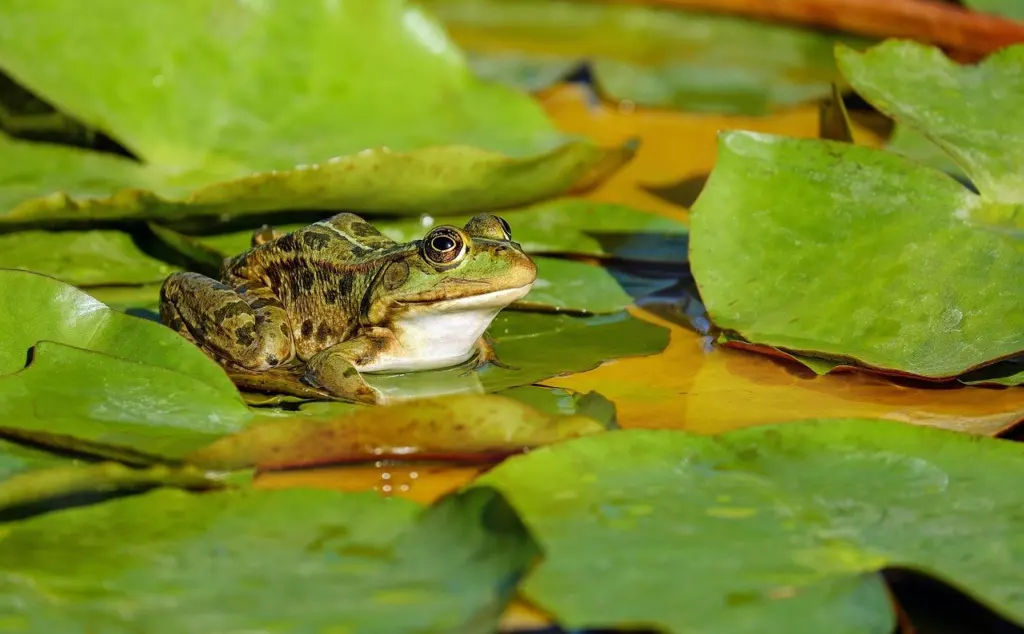
The chain on BBC Bitesize is Grass → grasshopper → frog → hawk. Grass is the producer and every animal after it is a consumer. The frog is both a predator of the grasshopper and prey for the hawk. That double role is worth pausing on, because it shows why one animal can sit in more than one chain once children move on to webs.
Shrubs, rabbits and bears
The MPA Alive lesson offers a simple chain that links the shrubs, the rabbits that eat shrubs, and the bears that eat the rabbits. It has only three links, which makes it a good first chain for the youngest children. Ask them to point to the producer, the plant eater and the animal eater in turn.
The sea: starting with plankton
In the sea, plankton are tiny animals and plants, as BBC Bitesize describes them. They are far too small to see in a bucket of water, so a sea chain needs pictures. Show a plankton image first, then let children use a picture book or class reference to decide which sea animals could come next. This turns the chain into a research task rather than a memorised list.
Why chains stay short
Children often want to keep adding animals until the chain fills the page. Energy is the reason this does not work. BBC Bitesize says energy is lost to the surroundings as it passes from one level to the next, so there are fewer organisms at each higher level. The MPA Alive lesson makes the same point, noting that a large amount of energy is lost at each link, and that most food chains have no more than four or five links.
For teaching, treat that figure as a typical pattern, not a rule to enforce. If a child wants to keep adding links, suggest starting a second chain and linking the two where they share an organism. That is how a web is built, and it avoids teaching an unsupported chain length.
An observation activity: draw what lives nearby
The best habitat-by-habitat lesson uses the habitat outside the door. The MPA Alive lesson opens with a pre-assessment in which students draw a diagram of what a nearby organism eats. That works as an observation task for a yard, a park or a pond edge.
- Choose a spot. Pick a small area and agree to look quietly for a few minutes.
- Pick one organism. Choose something you can see, such as a plant, an insect or a bird, and draw it.
- Draw what it eats. Add its food next to it. If you did not see it feeding, write “I think” beside the drawing and check later with a book.
- Add what eats it. Extend the chain in whichever direction you can support from what you saw or read.
- Label the roles. Mark the producer and the consumers, and add a decomposer label beside the chain.
- Draw the arrows. Point each arrow from the food to the eater.
Two follow-ups from the same lesson turn drawings into models. In the paper-strip task, each student uses strips of colored paper to create a food chain, and a colour for each role makes the pattern visible at a glance. For a web, begin by having one student serve as the sun, then link organisms with yarn. A natural question to end on is what happens to the web if one organism’s population falls, since BBC Bitesize notes that such a change affects other organisms.
Where to go next
Food chains teach children to follow a flow of energy step by step, and Earth science rewards the same patient, ordered thinking. When the class is ready for a new topic, Inside Planet Earth: The 7 Layers Explained — From Crust To Inner Core (2026 Guide) – Ricecatalyst walks through the layers one at a time, and Inside Earth’s Mechanics: A Clear Guide To The Mechanical Layers Of The Earth (2026) – Ricecatalyst covers how those layers behave.
Frequently asked questions
| Question | Answer |
|---|---|
| What is a food chain? | It is a list of organisms in a habitat showing what eats what, joined by arrows that show energy moving from one organism to the next. |
| What is an example of a food chain? | Grass → grasshopper → frog → hawk is a simple one. Oak tree → acorn → mouse → owl and shrubs → rabbits → bears are two more. |
| How is a food chain different from a food web? | A chain is a single path. A web is a network of connected paths made of several chains, so a change to one organism can affect the whole web. |
| Where does the energy in a food chain start? | With the sun. Green plants capture it by making their own food, and consumers get it by eating plants or other animals. |