
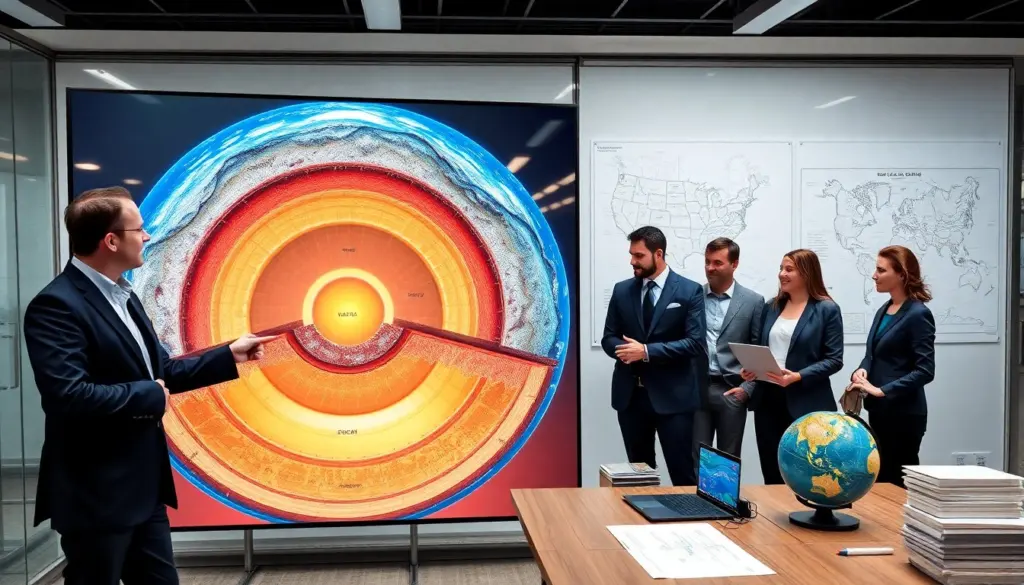
The 7 layers of the earth describe Earth’s structure from the outer skin to the center. Scientists divide Earth into seven layers to explain composition, temperature, and behavior. This guide lists each layer by name and role. It shows how the 7 layers of the earth connect and how they affect surface events such as earthquakes and volcanic eruptions.
Key Takeaways
- The 7 layers of the earth range from the outer crust to the inner core, each with distinct composition and properties.
- The crust forms Earth’s surface, consisting of continental and oceanic types, and hosts life while enabling surface events like earthquakes.
- The lithosphere, including the crust and upper mantle, contains rigid tectonic plates whose movement causes major geological activities.
- Below the lithosphere, the asthenosphere is a weak, flowing layer that facilitates plate motion and magma ascent.
- The deeper layers, including the upper mantle, lower mantle, and outer core, contribute to heat transfer and generate Earth’s magnetic field.
- The inner core is a solid iron-nickel center under extreme pressure, influencing the magnetic field and Earth’s internal dynamics.
Crust: Continental And Oceanic Skin Of The Planet
The crust forms the outermost layer of the 7 layers of the earth. It contains continental crust and oceanic crust. Continental crust sits higher and has lower density. Oceanic crust sits lower and has higher density. The crust hosts soils, rocks, and life. It averages 30–50 km under continents and 5–10 km under oceans. Seismic waves travel faster in the crust than in deeper layers. The crust breaks into pieces that move on the layers below. These breaks cause many surface events.
Lithosphere: The Rigid Plates That Move
The lithosphere forms one of the upper layers in the 7 layers of the earth. It includes the crust and the rigid top part of the mantle. Tectonic plates live in the lithosphere. Plates move slowly over time. Plate motion causes earthquakes, mountain building, and ocean formation. The lithosphere varies in thickness from about 5 km under oceans to over 200 km under old continents. Scientists map lithospheric plates by using seismic data and GPS. The lithosphere acts as a strong shell that interacts with the softer layer beneath.
Asthenosphere: The Weak, Flowing Upper Mantle
The asthenosphere sits below the lithosphere in models of the 7 layers of the earth. Heat and pressure render the asthenosphere soft and partially molten. It flows slowly and lets the lithosphere move above it. Convection in the asthenosphere helps drive plate motion. The region extends roughly 100–700 km beneath the surface in many models. Seismic waves slow when they pass through the asthenosphere. The asthenosphere plays a key role in how plates break and how magma reaches the surface.
Upper Mantle: Transition Zone And Composition
The upper mantle forms part of the middle layers in the 7 layers of the earth. It lies directly beneath the crust and above the lower mantle. The upper mantle contains a transition zone with minerals that change form under pressure. The zone spans roughly 410–660 km depth. The upper mantle shows increasing density and temperature with depth. Rock in this zone is solid but can flow over long times. Scientists study the upper mantle with seismic imaging and lab experiments on mineral physics to infer its composition and behavior.
Lower Mantle: Deep, Dense Rock And Heat Transfer
The lower mantle forms a vast portion of the 7 layers of the earth. It extends from about 660 km to 2,900 km depth. The lower mantle contains dense silicate minerals under high pressure. Heat moves through this layer by slow convection and by conduction. Convection in the lower mantle can influence surface geology over long times. Seismic velocities increase steadily through the lower mantle. The lower mantle stores heat that drives mantle plumes and long-term tectonic processes. It acts as the main thermal engine for the planet.
Outer Core: The Liquid Iron Layer That Generates Earth’s Magnetic Field
The outer core forms a liquid shell in the standard list of the 7 layers of the earth. It lies between the lower mantle and the inner core at depths from about 2,900 km to 5,150 km. The outer core contains molten iron and nickel. Convection in this liquid and Earth’s rotation create the geomagnetic field by the dynamo effect. Seismic waves that require rigidity do not pass through the outer core, which confirms its liquid state. The outer core also transfers heat upward into the mantle.
Inner Core: The Solid, Extreme-Pressure Center
The inner core forms the central part of the 7 layers of the earth. It spans roughly 1,220 km in radius and sits at the planet’s center. High pressure forces iron and nickel into a solid state even though extreme temperatures. The inner core may rotate slightly faster than the surface. It affects the outer core flow and so the magnetic field. Seismic waves that pass through the inner core reveal its solid nature and offer clues about its growth and composition over geological time.