
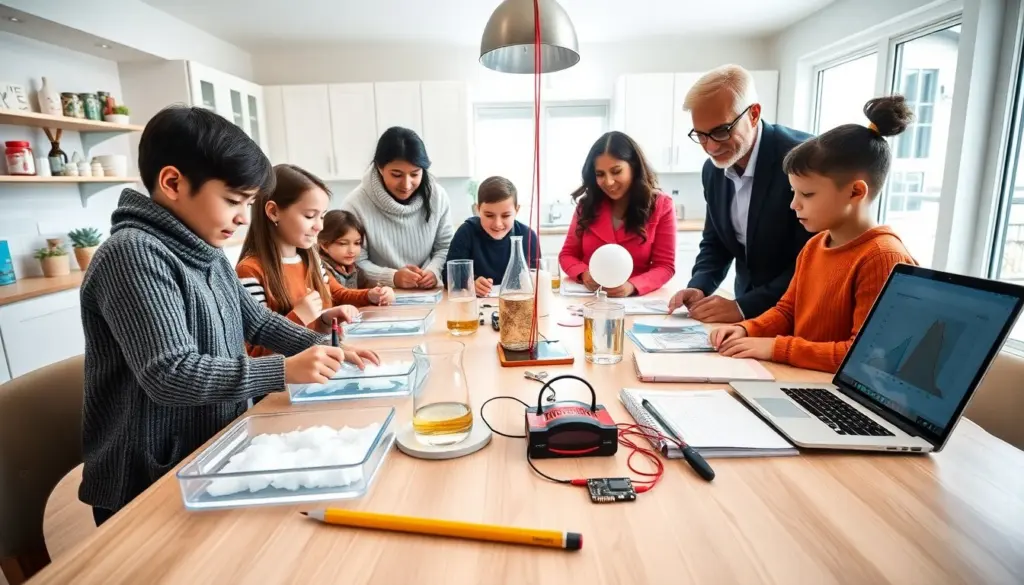
Winter STEM activities give families fun, low-cost learning when weather keeps them inside. Teachers and parents can pick activities that match age and skill. This guide lists clear options for preschoolers through teens. It also shows simple materials, steps, and learning goals. Readers will find ideas that use pantry items, household tools, and free coding resources.
Key Takeaways
- Winter STEM activities offer engaging, low-cost learning opportunities indoors during cold weather, tailored to different age groups from preschoolers to high schoolers.
- For young children, winter STEM activities focus on sensory experiences and simple cause-effect experiments like ice melting and snowflake tracing.
- Elementary students benefit from hands-on experiments exploring states of matter and measurement, such as salt crystal growth and simple circuits.
- Middle and high school students tackle more complex challenges including insulation testing, engineering prototypes, and coding temperature sensors to build problem-solving and technical skills.
- Selecting appropriate winter STEM activities involves matching safety, materials, and clear learning goals to the child’s age and skill level for effective engagement and education.
Quick Guide: Choosing Winter STEM Activities For Different Ages
Preschoolers need safe, sensory tasks. Caregivers should pick activities with few parts and clear outcomes. Examples include ice melting with salt, snowflake symmetry tracing, and simple sink-or-float tests. Young children learn cause and effect.
Elementary students need hands-on experiments with short explanations. Educators can use winter STEM activities that teach states of matter, temperature, and basic measurement. For example, they can compare ice melt times, build simple circuits to light LEDs, or grow salt crystals. These tasks teach observation, recording, and hypothesis testing.
Middle schoolers need deeper challenges. Teachers can assign projects that require planning, iteration, and basic math. Students can design insulated containers, test insulation materials, or program a microcontroller to monitor temperature. These winter STEM activities build problem solving and data skills.
High schoolers need open-ended tasks with clear goals. Mentors can assign engineering design problems like efficient snowmelt systems or winter-ready shelters. Students can use coding, simulation, and prototyping. These activities prepare students for lab practices and technical communication.
When choosing a task, adults should match safety, time, and materials to the child. Adults should set one clear learning goal per activity. They should give children a brief challenge and then let them test ideas.
Five Simple Indoor Science Experiments You Can Do With Pantry Ingredients
- Salt and Ice Race
Materials: ice cubes, table salt, two trays, timer.
Steps: Place ice on trays. Sprinkle salt on one tray and leave the other plain. Time how long each cube takes to melt. Record results.
Learning goals: Students learn how salt lowers freezing point and accelerates melting. They learn to measure time and compare results.
- Homemade Snow
Materials: baking soda, hair conditioner, tray.
Steps: Mix baking soda and conditioner until texture feels like snow. Pack the mixture and shape it.
Learning goals: Students explore mixtures and physical properties of solids. They observe texture and cohesion.
- Density Parfait
Materials: honey, dish soap, water, oil, food coloring, small objects.
Steps: Layer liquids by density in a clear cup. Drop small objects and watch where they settle.
Learning goals: Students learn about density and buoyancy. They practice predicting and testing.
- Crystal Growth with Salt or Sugar
Materials: salt or sugar, hot water, jar, string, pencil.
Steps: Dissolve salt or sugar fully in hot water. Tie the string to the pencil and suspend it in the solution. Wait several days and observe crystal growth.
Learning goals: Students learn about saturation and crystallization.
- Static Snowflake Attraction
Materials: tissue paper, balloon.
Steps: Cut small tissue snowflakes. Rub the balloon on hair then hold it near the flakes. Watch the flakes jump to the balloon.
Learning goals: Students learn about static electricity and charge attraction.
Three Engineering And Coding Challenges To Keep Kids Busy On Snow Days
- Insulated Lunch Box Challenge
Materials: small box, foil, foam, fabric scraps, tape, thermometer.
Steps: Students design an insulated box to keep a small container warm or cold. They test different materials and record temperature change over time.
Learning goals: Students learn heat transfer, conduction, and experimental controls.
- Snowblower Blocker Prototype
Materials: cardboard, craft sticks, rubber bands, glue, scissors.
Steps: Students design a simple deflector that redirects falling material in a model driveway. They build prototypes and test with small beads or packing peanuts.
Learning goals: Students learn iterative design, testing, and structural stability.
- Winter Weather Station with Code
Materials: microcontroller (micro:bit, Arduino, or low-cost board), temperature sensor, USB cable, computer, free coding platform.
Steps: Students connect the sensor to the board, upload simple code, and read temperature values on a screen. They log data over several hours and plot changes.
Learning goals: Students learn basic electronics, coding, and data logging.
Sample Activity Plans (With Materials, Steps, Learning Goals)
Activity Plan A: Melt Race (Elementary)
Materials: 4 ice cubes, 2 plates, salt, sugar, timer, notebook.
Steps: Place two ice cubes on each plate. Sprinkle salt on one cube and sugar on the other. Start timer and note melting progress every minute.
Learning goals: Students test how additives affect melting. They practice recording observations and drawing conclusions.
Activity Plan B: Insulation Test (Middle School)
Materials: 3 small boxes, foil, cloth, foam, thermometer, hot water in sealed bottle.
Steps: Wrap each box in a different material. Place the hot water bottle inside each box. Measure temperature every 10 minutes for one hour.
Learning goals: Students compare thermal resistance. They calculate rate of heat loss and justify the best material choice.
Activity Plan C: Microcontroller Temp Logger (High School)
Materials: microcontroller, temperature sensor, USB cable, computer, spreadsheet software.
Steps: Connect sensor to microcontroller. Upload code to read temperature every minute. Collect data for 24 hours and analyze daily variation.
Learning goals: Students learn sensor interfacing, basic coding, and data analysis. They practice plotting and interpreting real data.
These winter STEM activities use low-cost materials and clear goals. They let children test ideas, repeat steps, and improve designs. Adults can adapt time and difficulty to the child’s skill.