
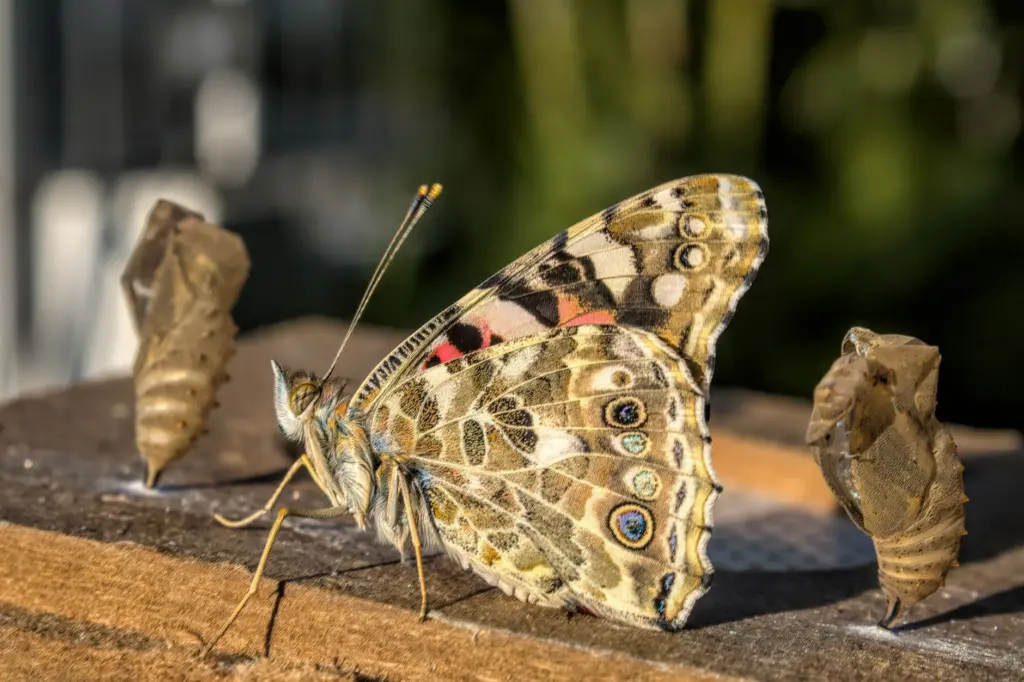
A caterpillar on a leaf and a butterfly on a flower look like different animals, but they are the same insect. The life cycle of a butterfly runs through egg, larva, pupa and adult, and the body is rebuilt along the way.
Every duration below is a range, because timing depends on the species. Treat each figure as a typical case, not a promise. For the habits that make careful observation useful, see the scientific method steps explained in the Science Concepts Explained hub.
The stages in order
The sequence never changes, even though the time spent in each stage does. Each stage has its own job:
- Egg. Laid by the female on a host plant, this is where each individual begins.
- Larva. The caterpillar is the feeding and growing stage. It molts, and each growth stage between molts is called an instar.
- Pupa. The chrysalis stage, where the body is taken apart and rebuilt.
- Adult. The winged butterfly that emerges, dries its wings and flies off.
The change in body form across these stages is metamorphosis. The Louisville Zoo describes the chrysalis as the place where the insect is undergoing a transformation, or “metamorphosis.” A caterpillar is not a young butterfly that slowly grows wings. It is a different body that is rebuilt into the adult.
Common misunderstandings, checked against the evidence
Several ideas cause most of the confusion about butterflies. The table sets each one against what museum and conservation sources report, and the stage sections below unpack them.
| Common assumption | What the evidence shows | Stage |
|---|---|---|
| Caterpillars simply stretch as they grow | The skin is an exoskeleton with limited stretching capacity, so it becomes tight, splits and is shed | Larva |
| The chrysalis is a resting phase | The body parts of the caterpillar break down and reform to make the adult | Pupa |
| Eggs hatch on a fixed timetable | Most species hatch in 4-5 days, while others may take as long as three weeks | Egg |
| Adult butterflies live for months | The average adult lifespan is two weeks, ranging from several days to 11 months | Adult |
These descriptions and figures come from the Florida Museum of Natural History and Butterfly Conservation.
Eggs: laid with a purpose, hatched on a variable schedule
The egg is where the life cycle starts, and the location is not random. According to the Florida Museum of Natural History, females often lay eggs on specific host plants, and the eggs vary in shape and size depending on the species. The host plant matters because the caterpillar that hatches feeds on it. The leaf is therefore both nursery and first meal.
The common assumption is that eggs hatch on a fixed timetable. The same museum page reports that most species hatch in 4-5 days, while others may take as long as three weeks. That spread has a practical meaning for anyone watching eggs. If nothing has hatched after several days, that alone does not signal a problem, because the species may simply be one of the slower ones. Identify the species before judging the timing, and use the longer figure as an upper end rather than a target.
Caterpillars: growth by feeding and molting
The larva stage is the caterpillar, and its main job is growth. The Louisville Zoo explains that caterpillars must grow quickly, so they eat continually. The scale of that growth is large. National Geographic Kids reports that a fully grown caterpillar can be over 100 times larger than when it emerged from its egg. That is why the larva spends its time feeding instead of moving on.
Why molting is needed
A caterpillar cannot stretch to fit a bigger body. The Florida Museum explains that its skin is an exoskeleton with a limited stretching capacity, so the skin becomes tight and eventually splits and sheds. That shedding is a molt. Each growth stage between molts is an instar, which means a caterpillar passes through a series of instars on its way to the pupa.
How many molts to expect
Butterfly Conservation states that most caterpillars shed their skin five times in total, while National Geographic Kids gives four or five. Read that as a typical count rather than a rule for every species. Counting molts is a practical way to track how far a caterpillar has progressed through its instars.
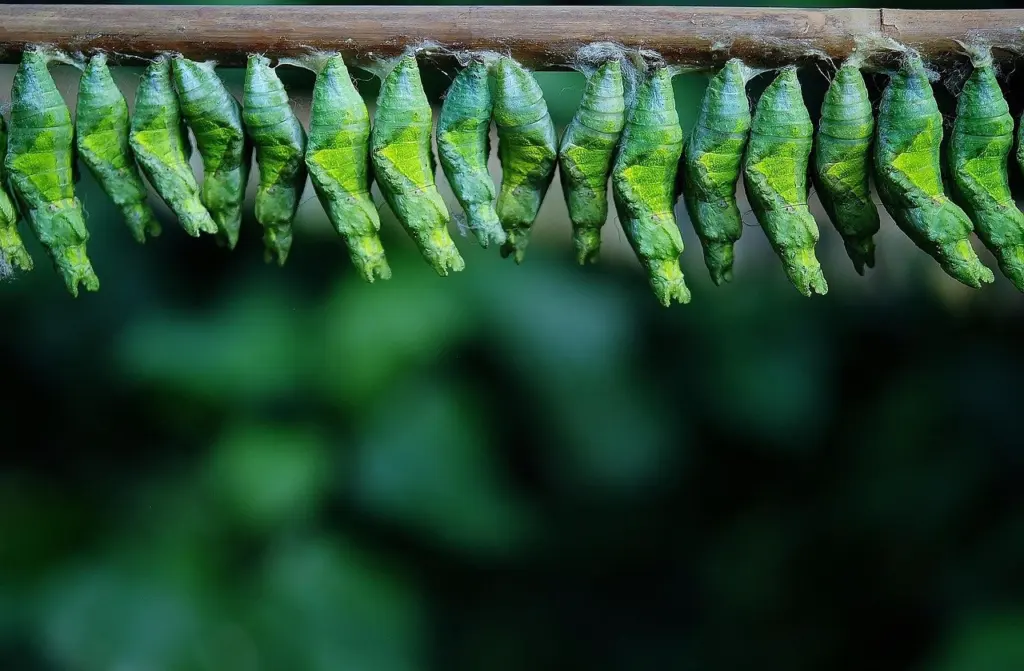
The chrysalis: busy, not resting
From outside, a chrysalis looks still, which is why it is so often called a resting stage. That is the misunderstanding most worth correcting. Stillness on the outside hides a complete rebuild on the inside.
The protective case
According to National Geographic Kids, a hardened case forms around the pupa to protect it from predators and extreme weather conditions. The case gives the pupa shelter, but it does not make the stage short or uniform, as the duration figures below show.
What happens inside the chrysalis
The Florida Museum describes the caterpillar breaking down most of its body into a “tissue cell soup,” from which the adult’s wings, legs and eyes form. Butterfly Conservation puts it in plainer terms: the body parts of the caterpillar break down and reform to make the adult butterfly or moth. Together these descriptions explain why a caterpillar and a butterfly look so different. The adult is not an enlarged caterpillar. It is assembled from rebuilt tissue.
How long the pupa stage lasts
The pupa stage is the least predictable in length. National Geographic Kids says it may last a few weeks to several months depending on the species. Butterfly Conservation says the transformation before the adult emerges can take anywhere from a week to a year, depending on the species. A chrysalis that is still intact after several weeks is therefore not necessarily stalled. Check the species before drawing a conclusion.
Adult butterflies: emergence and a short average lifespan
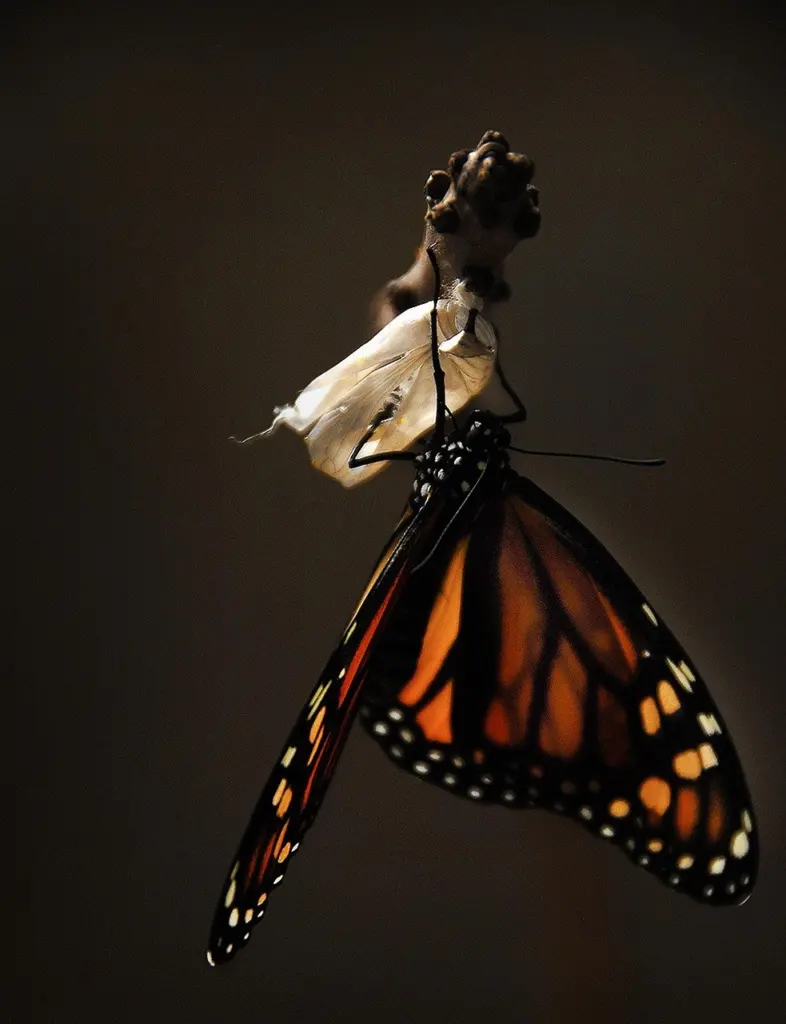
The adult leaves the chrysalis with wings that are not yet ready to fly. The Florida Museum describes the wings being inflated by pumping fluid into the wing veins. The butterfly then waits up to two hours for its wings to dry. The Louisville Zoo describes the same step as the butterfly pumping blood into its wings after a rest period. A newly emerged butterfly that clings to its empty case without flying is therefore doing a necessary job, not showing a fault. The two-hour figure is a ceiling, not a set time.
How long adults live
Adult life is where the “butterflies live for months” assumption fails most clearly. The Florida Museum gives an average adult lifespan of two weeks, ranging from several days to as long as 11 months. Use the two-week average as the typical case. The 11 months is the upper end for some species, and it is not an expectation for any butterfly you happen to see. Because lifespan ranges by species, a quoted figure only makes sense once the species is known.
Turning the stages into observations
Because durations vary so widely, a timing question about one species cannot simply be answered with a figure from another. That makes the life cycle a good subject for a testable question, such as how long one species spends in a given stage. For templates on phrasing a prediction like that, see Examples Of A Hypothesis: 7 Testable Templates And Real-World Examples (2026 Guide) – Ricecatalyst. Record the species, the stage and the date of each change, so that durations are compared like with like.
Frequently asked questions
| Question | Answer |
|---|---|
| How many eggs does a butterfly usually lay? | A butterfly usually lays 200-500 eggs, according to the Florida Museum of Natural History. This is a usual range, not a fixed count for every species. |
| Do caterpillars eat anything other than leaves? | Almost all caterpillars eat leaves, but the Florida Museum notes that some eat stems, roots, fruits, seeds, seed pods or flowers. |
| What do adult butterflies do once their wings have dried? | According to National Geographic Kids, the adult takes to the air in search of flowers to feed on and of other butterflies to mate with. |