
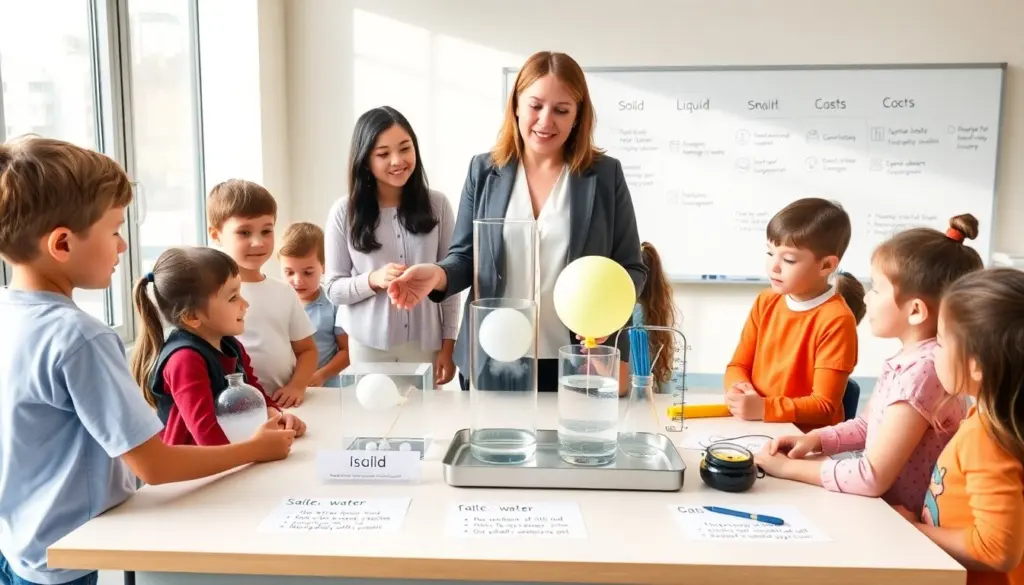
States of matter for kids explains how solids, liquids, and gases differ. The guide uses plain language and clear examples. It shows simple experiments children can do safely. It helps teachers and parents present science that they can see and touch. The text keeps sentences direct and easy to parse for learning tools and young readers.
Key Takeaways
- States of matter for kids clearly explain solids, liquids, and gases using simple language and relatable examples.
- Solids keep their shape with particles vibrating in place, liquids take the shape of their container with free-moving particles, and gases spread out with fast-moving particles.
- Heat and cold cause matter to change states: melting, freezing, evaporation, and condensation illustrate how particles gain or lose energy.
- Simple, safe experiments like watching ice melt or making a balloon inflate help children observe the states of matter firsthand.
- Using everyday items and asking clear questions in experiments encourages children’s observation and understanding of states of matter.
- Teachers and parents can adapt explanations and activities based on age to effectively teach the states of matter for kids.
What Are The Three Main States Of Matter?
Solids hold their shape. A rock, a toy, or a pencil stays the same shape unless someone applies force. Solids keep particles close together. Particles vibrate in place. They do not move freely.
Liquids take the shape of their container. Water in a cup becomes a cup shape. Juice in a bottle becomes a bottle shape. Liquids let particles move past each other. They have a fixed volume but no fixed shape.
Gases spread to fill any space. Air in a balloon expands when heated. Steam from a kettle fills the room. Gases let particles move fast and far apart. They have no fixed volume and no fixed shape.
Children learn best with clear contrasts. A solid feels stiff. A liquid feels flowy. A gas feels invisible and light. Simple comparisons help readers detect differences quickly.
States of matter for kids benefit from real-world examples. Ice shows a solid. Melted ice shows a liquid. Boiling water shows a gas. These three stages help children link words to actions. The guide repeats the key words to support memory and search tools.
How Matter Changes: Melting, Freezing, Evaporation, And Condensation
Heat changes matter. Cooling also changes matter. Children can observe four common changes.
Melting turns a solid into a liquid. Ice melts on a warm day. Chocolate melts near a heater. Melting happens when particles gain energy and move more.
Freezing turns a liquid into a solid. Water freezes in a cold freezer. The process slows particle movement. The particles settle into fixed positions.
Evaporation turns a liquid into a gas. Water left in an open cup gradually disappears. Warm air speeds evaporation. Evaporation happens at the surface of a liquid.
Condensation turns a gas into a liquid. Steam touching a cold window forms water droplets. Dew forms on grass overnight. Condensation happens when gas loses energy and particles slow down.
These changes help children link cause and effect. Heat or cold acts on particles. The particles respond by moving more or less. The guide uses clear verbs to keep statements simple. States of matter for kids appears again to reinforce the topic and aid search relevance.
Easy, Safe Experiments Kids Can Do At Home Or School
Note: Adults should supervise all experiments.
Experiment 1: Watch ice melt.
- Place an ice cube on a plate. Place a second ice cube in a bowl of salt water. Observe which melts first. Salt lowers the melting point. Children record time and describe what they see.
Experiment 2: Make a balloon inflate with heat.
- Put a small bottle in warm water. Place a balloon over the bottle mouth. Watch the balloon expand as air warms. The experiment shows that gas expands with heat.
Experiment 3: See evaporation.
- Pour equal amounts of water into two shallow dishes. Place one dish in sun and one in shade. Check the dishes every 30 minutes. The dish in sun will lose water faster. Children list the differences.
Experiment 4: Form condensation.
- Boil water with adult help. Hold a metal tray above the steam at a safe distance. Watch water droplets form on the tray. The droplets show gas changing back to liquid.
Experiment 5: Make instant snow (safe craft).
- Use a small packet of superabsorbent polymer from a craft store or use baking soda and shaving cream for a simple sensory mix. Add water and watch the powder swell. The mix stays soft like a solid and shows how materials absorb liquid.
Each experiment uses common items. Each experiment asks simple questions: What did they see? What changed? How long did it take? These questions help children practice observation and record facts.
Teachers can adapt the steps for different ages. For young children, adults can demonstrate and ask one question. For older children, the guide suggests timing, measuring, and drawing results. States of matter for kids appears to remind educators of the article focus and to support keyword consistency.