
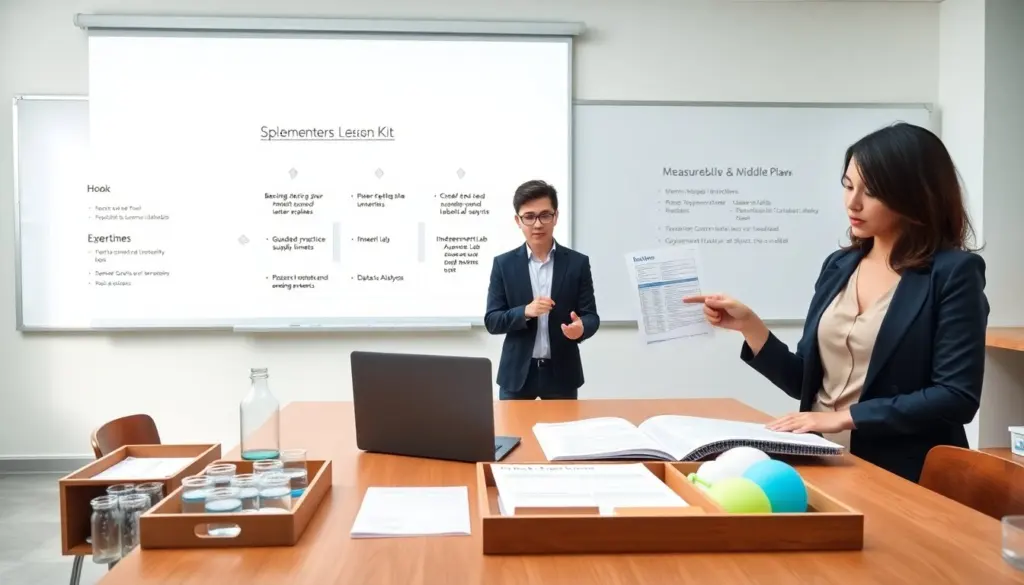
Science lesson plans help teachers save time and hit standards. The guide shows clear steps to build lessons that meet learning goals. It lists activities, materials, and assessments. Teachers will find ready-to-use templates and pacing guides. The content focuses on usability, alignment to standards, and classroom-tested methods.
Key Takeaways
- Science lesson plans save teachers time by providing clear, standards-aligned objectives and ready-to-use templates.
- Effective science lesson plans build skills progressively using hooks, guided practice, and independent tasks.
- Hands-on activities and simple experiments enhance engagement and deepen understanding of scientific concepts.
- Assessment strategies include formative and summative checks closely tied to learning goals and standards.
- Differentiation and technology integration support varied learners and extend lesson impact.
- Maintaining a resource bank and reusable templates streamlines planning and fosters consistent lesson quality.
Designing Standards-Aligned Science Lesson Plans That Meet Learning Goals
Teachers set learning goals first. They match goals to state or national standards. They write objectives that state what students will do and what they will know. Each objective uses measurable verbs like identify, describe, explain, or model.
Teachers plan a sequence of lessons that build skills. They start with a hook that introduces a problem. They add guided practice that shows steps and models thinking. They include independent tasks where students apply ideas.
Teachers pick content that fits grade-level expectations. They map standards to lesson outcomes and to assessments. They check for alignment by asking: Does the task measure the stated standard? If the answer is no, they adjust the task or the objective.
Teachers use time blocks that reflect the depth of the topic. Short lessons focus on vocabulary and key concepts. Longer lessons include experiments and data collection. Teachers plan transitions and materials to reduce lost time.
Teachers document success criteria. They tell students what success looks like and show a sample product or rubric. They use exit tickets or quick checks to confirm that students reached the objective. Teachers revise future science lesson plans based on this data.
Teachers keep one reusable template. The template lists standards, objectives, materials, step-by-step procedures, checks for understanding, and assessment methods. This template speeds planning and keeps lessons aligned across a unit.
Engaging Hands-On Activities, Experiments, And Demonstrations
Teachers choose hands-on activities that connect to real phenomena. They pick tasks where students make predictions, test, and record results. These tasks increase engagement and deepen understanding.
Teachers use simple experiments to teach core ideas. For example, they use cups, water, and salt to show density. They use balloons and static electricity to show charge. These low-cost experiments work well across grades.
Teachers design step-by-step lab instructions. Each step uses clear verbs and short sentences. They list materials in order of use. They mark safety notes and clean-up tasks.
Teachers group students for labs by skill and behavior. They assign roles such as reader, recorder, measurer, and reporter. These roles keep students accountable and spread work evenly.
Teachers include demonstrations to model difficult ideas. A teacher might demonstrate chemical reactions while students record observations. Demonstrations set expectations for safe technique and accurate note taking.
Teachers add data analysis to every experiment. They teach students to make tables, draw simple graphs, and state patterns. They ask short analysis questions like: What did you change? What did you measure? What pattern appears?
Teachers vary complexity. Early grades use guided activities with clear steps. Upper grades include inquiry tasks where students design tests. Teachers label each science lesson plan with the expected student independence level.
Teachers keep a kit of common supplies. The kit includes basic lab tools, timers, rulers, and inexpensive sensors. The kit reduces prep time and lowers the barrier to frequent hands-on work.
Assessment Strategies, Differentiation, And Ready Resources For Every Grade
Teachers use multiple assessment types. They use formative checks during a lesson and summative tasks at unit end. Formative checks include thumbs-up, quick quizzes, and short lab notes. Summative tasks include unit tests, projects, and student presentations.
Teachers align assessments to standards and objectives. They write rubrics that show clear criteria for each performance level. They share rubrics with students before work begins. This practice sets clear expectations and reduces confusion.
Teachers plan differentiation in every lesson. They offer scaffolded directions for students who need help. They provide extension tasks for students who finish early. They change reading level, reduce steps, or offer visual supports when needed.
Teachers use small-group instruction to support varied learners. They pull a small group to reteach a concept or to provide challenge tasks. They record group notes to track progress and adjust future science lesson plans.
Teachers use technology to extend reach. They assign short simulations to model complex systems. They use video clips to preview labs and to review safety procedures. They use digital quizzes to gather fast data about learning.
Teachers build a resource bank of ready materials. The bank includes printable handouts, slide templates, data tables, and rubric examples. Teachers tag each resource by grade, standard, and time needed. This system saves planning time.
Teachers evaluate resources each semester. They keep what works and replace items that do not yield student growth. They update the science lesson plans archive so teams can reuse strong units.