
A class builds craft-stick bridges, yet the math stays on the worksheet. Math STEM activities for middle school work when measurement, data or code decides the design and students must defend each choice with numbers.
Teachers planning a full inquiry cycle can pair these lessons with the science fair project steps, then use the sections below to pick, run and assess each task.
What Math STEM Means At This Level
Middle school students can handle more than exposure. Kid Spark notes that learners at this stage can be introduced to complex engineering, robotics, prototyping, intermediate mathematics and computer science. The practical consequence is that a single task can carry geometry, data analysis and coding together, as long as the math is required to finish it.
The most common mistake is assuming that a hands-on build is automatically a math lesson. Students can glue sticks together for a whole period and never calculate, compare or justify anything. The table separates the usual assumptions from what the evidence supports.
| Common assumption | What holds up | Planning use |
|---|---|---|
| Building the bridge is the math | The popsicle-stick bridge task uses sticks, glue and weights, and students explore load distribution, structural stability and material strength. | Ask for recorded measurements and a numeric reason behind every revision, not just a finished bridge. |
| Data work needs its own separate unit | An Alka-Seltzer rocket becomes a math activity by charting distances by rocket materials, and a tsunami tank by charting wave size and speed. | Add a chart and a conclusion to an experiment you already run. |
| Robotics belongs only in an engineering class | Robotics with LEGO Mindstorms or VEX kits is listed for grades 6-8 and builds critical thinking, logical reasoning and teamwork. | Treat it as a coding and geometry task where students justify movement and sensor decisions. |
Figures and task descriptions come from Tynker’s STEM activity list and Homeschool Academy’s outdoor project guide.
Bridge Challenge: Geometry, Forces And Measurement
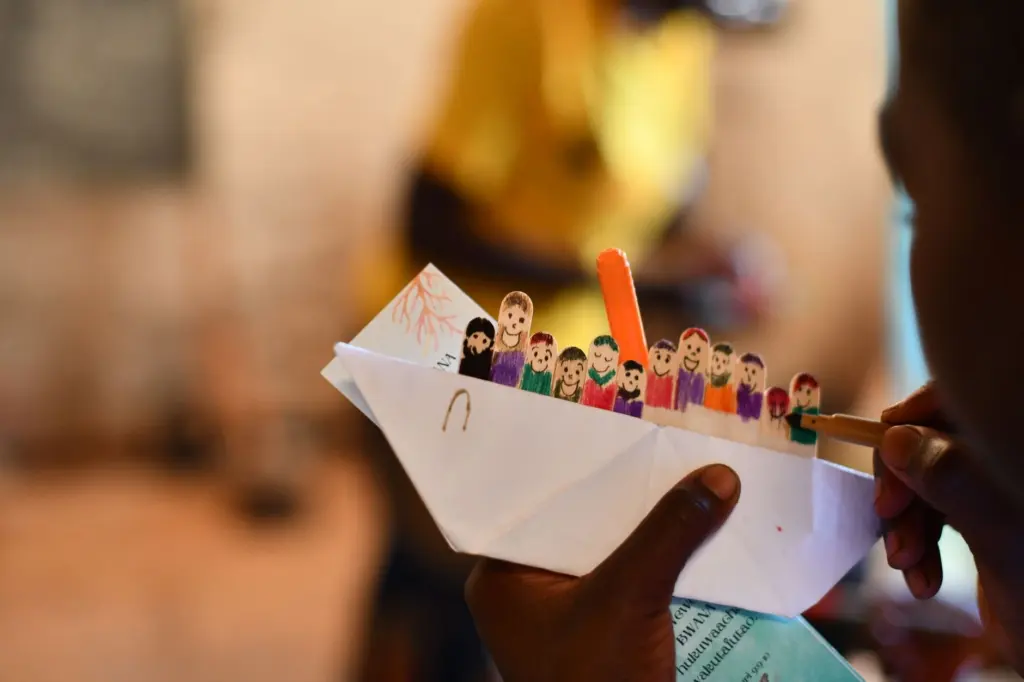
The bridge challenge suits classes that need a concrete way into geometry and engineering at once. Tynker describes students designing and constructing bridges with popsicle sticks and glue, aiming to hold maximum weight. The same page frames engineering challenges as a cycle of designing, building and testing solutions to real-world problems, which is the structure to keep.
Running the lesson
- Launch with constraints. State the gap to span, the materials allowed and the testing method, so students know the design must be measurable.
- Sketch to scale. Teams draw the bridge with labeled dimensions and predict where it will carry load, using proportional reasoning rather than guesses.
- Build and test. Add weights gradually, record the load at failure and note where the structure gave way.
- Revise with evidence. Each change must be tied to a recorded measurement or a test result, then retested.
- Present the reasoning. Teams explain which geometric choice improved performance and show the data that proves it.
Note that holding the most weight is a contest result, not the learning target. Reward the quality of the numeric justification, or the strongest bridge will simply belong to the team with the most glue.
Other engineering pairings
- Spaghetti bridge: Lumiere Education says this task introduces structural engineering and the forces of tension and compression, and applies math and physics to a real problem.
- Rube Goldberg machine: the same source describes planning and iteration as the way students apply physics and engineering principles, which makes it a good fit for teams that need to document each trial.
Students who enjoy the force-and-load side can continue with Physics Science Fair Projects: 25 Easy, Proven Ideas And How To Ace Your Experiment (2026) – Ricecatalyst, which turns similar ideas into testable experiments.
Data Analysis With Sports Statistics And Experiment Charts
Data analysis lessons work best when students collect or choose data that matters to them. Sports statistics are a natural context, and a classroom experiment can serve equally well. Homeschool Academy points out that middle school is when students go beyond exposure and begin experimenting with fundamental math concepts such as geometry and algebra, and charting is the simplest way to add that math to an experiment.
A sports statistics sequence
- Pose a question. Students ask something a dataset can answer, such as how a team’s scoring varies from game to game.
- Clean the data. Check for missing entries and define each column before any calculation.
- Calculate and graph. Compute measures of center and spread, then choose a bar chart, histogram or boxplot that fits the question.
- Interpret with limits. Students state a conclusion, say what the data cannot show, and explain how a small sample could mislead them.
Charting experiments you already run
Homeschool Academy suggests turning an Alka-Seltzer rocket into a math activity by charting distances by the materials used, and a tsunami tank into one by charting wave size and speed. Both work because the variable being changed is clear and the outcome is measurable. A teacher who already owns the materials needs only a data table and a short written claim to convert a demonstration into data analysis.
Students should finish each data task with a recommendation tied to the numbers, such as which rocket material to choose and why, so the chart serves a decision.
Coding A Math Game Or Chatbot
Coding is a natural fit because many middle schoolers arrive comfortable with computers, as Kid Spark observes. The math comes in when students must translate an expression, a rule or a scoring system into instructions that a computer can follow exactly. A wrong formula produces a visibly wrong game, which makes debugging a form of mathematical reasoning.
Choosing the coding task
- Math game: students program a quiz or scoring game where variables track the score and conditions decide the feedback. Each feature should map to a stated math target, such as evaluating an expression correctly.
- Python chatbot: Lumiere Education lists string manipulation, input/output commands and conditional statements as the skills practiced, and recommends it for students with basic coding knowledge.
- CAD and printing: Kid Spark describes a unit in which students learn a CAD system, design a three-dimensional prototype and print a custom airplane propeller, pairing spatial geometry with fabrication.
If the class is new to code, pick the game and let students sketch the rules and write pseudocode first. Save the chatbot for students who already know the basics, since the text-handling skills build on them.
Ask students to write a short note explaining which math idea each section of the program implements and how they found and fixed one error. That note is where the mathematical thinking becomes visible.
Aligning Lessons With Standards
Alignment starts with the standard, not the activity. Unpack the relevant standard from your district or state math and science documents into a small number of measurable targets, then check that the task forces students to use those targets rather than treating math as decoration. If students can finish the build without ever using the target skill, change the task or add a required calculation.
Ready-made ideas can shorten this step. MIND Research Institute offers lesson ideas aligned to standards that engage students in math through the art of tiling, along with video instructions for two math dance activities that incorporate angles and digits. Check any ready-made lesson against your own standards, since the listing does not name specific ones.
The pairing of math practices with engineering and coding is what makes a lesson defensible to administrators. A bridge links scale and measurement to testing, a chart links data to a claim, and a program links an expression to behavior on screen.
Assessment And Differentiation
Assess the reasoning, not whether the bridge held or the game ran. A strong bridge can come from luck, and a broken program can contain excellent mathematical thinking. Useful evidence includes recorded measurements with units, a justification that cites data, a revision log and a short explanation of the math behind the final product.
- Quick checks: an exit ticket asking for one calculation and a sentence of explanation shows who can apply the idea alone.
- Rubrics: score a small number of criteria, such as accurate measurement, defended design choices and quality of revision, so students know what proficient work looks like.
- Varied outputs: accept annotated photos of a model, a written solution, a short video or a coding artifact as ways to show the same understanding.
- Packaged materials: Kid Spark notes that its unit packages include lesson plans, student workbooks, video tutorials and unit assessments, which can serve as models if you build your own.
For differentiation, Kid Spark describes the learning edge as a challenge that sits just beyond the comfort zone without being too large. Use that to set pacing. Give students who struggle templates, a smaller constraint set or a peer partner, and give advanced students a comparison of design variants or a more demanding program feature. Assessment results then decide the next groups: guided reteaching for some, extension tasks for others.
Teams working through a younger-grade project sequence can also see the Top 15 Easy, Safe Science Fair Projects For 5th Graders (With Steps & Tips) – Ricecatalyst for simpler entry points to the same investigative habits.
Frequently asked questions
| Question | Answer |
|---|---|
| Can one STEM resource serve several grades? | Often, yes. MIND Research Institute says most of its resources can be adapted to any grade level in elementary and middle school, so adjust the math demand rather than replacing the activity. |
| Where does CAD fit in a math lesson? | CAD suits geometry-heavy units. Kid Spark describes students designing a three-dimensional prototype and then printing a custom airplane propeller, so the design step carries the spatial reasoning. |
| How does a spaghetti bridge differ from a craft-stick bridge? | The spaghetti version puts the focus on the forces of tension and compression, according to Lumiere Education, and suits students with geometry or physics basics. The craft-stick version emphasizes load distribution, stability and material strength. |