
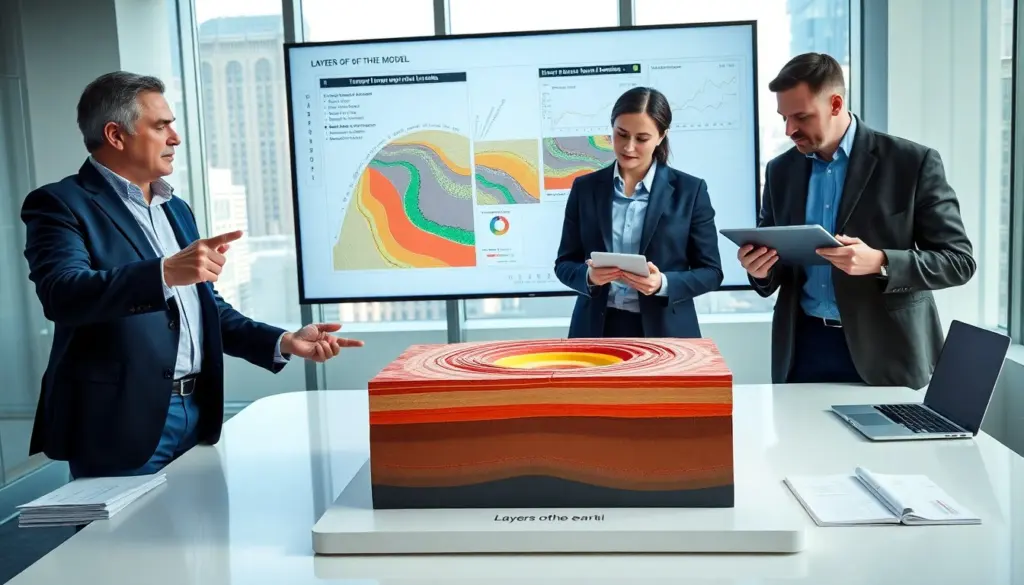
Scientists describe the layers of the earth model to explain Earth’s internal structure. The model shows distinct shells that differ by composition, state, and temperature. It helps researchers link surface processes to deep processes. This guide lists the main layers, compares their properties, and explains how they interact. Readers gain a concise map of Earth’s interior and the basic mechanics that drive geology and the magnetic field.
Key Takeaways
- The layers of the earth model divides Earth into distinct shells—crust, mantle, and core—each with unique composition, state, and temperature.
- Scientists use seismic data, rock samples, and experiments to build the layers of the earth model, linking surface phenomena like earthquakes to Earth’s interior structure.
- The crust is the outermost layer, with continental crust being thicker and less dense, and oceanic crust thinner and denser, influencing plate tectonics.
- The mantle, rich in magnesium and iron silicates, drives plate motion through solid-state convection and supplies magma for volcanism.
- Earth’s core consists of a liquid outer core and solid inner core made mostly of iron, playing a critical role in Earth’s magnetic field and thermal regulation.
How Scientists Conceptualize Earth’s Layered Model
Scientists build the layers of the earth model from seismic data, laboratory experiments, and rock samples. They record how seismic waves travel and change speed to infer density and state. They measure chemical composition in outcrops and in meteorites to infer original materials. They test minerals under pressure to define phase changes and melting points. The model divides Earth into shells with consistent properties. It lets scientists link earthquakes, volcanism, and plate motion to internal structure.
Crust: Composition, Types, And Typical Thickness
The crust forms the outermost skin in the layers of the earth model. It contains silicate rocks rich in silicon and oxygen. It holds most of Earth’s accessible minerals and soils. Continental crust contains more silica and lighter minerals. Oceanic crust contains denser basalt. Continental crust ranges from about 30 to 70 kilometers in thickness. Oceanic crust ranges from about 5 to 10 kilometers thick. The crust floats on the upper mantle because of density differences. People live on the crust and observe its deformation during earthquakes and mountain building.
Continental Versus Oceanic Crust — Key Differences
Continental crust sits higher and contains granite and lighter minerals. Oceanic crust sits lower and contains basalt and heavier minerals. Continental crust lasts longer and records ancient geological history. Oceanic crust forms at mid-ocean ridges and recycles back into the mantle at subduction zones. Continental crust averages thicker and less dense. Oceanic crust averages thinner and more dense. These differences drive plate buoyancy and the surface pattern of oceans and continents.
Mantle: Composition, Temperature Gradient, And Convection
The mantle occupies most of Earth’s volume in the layers of the earth model. It contains silicate minerals rich in magnesium and iron. Temperature increases with depth from about 500°C near the top to over 3,500°C near the core boundary. Pressure increases with depth and changes mineral structures. Heat transfer occurs by solid-state convection in many parts of the mantle. Convection moves mass and drives plate motion at the surface. The mantle also supplies magma to volcanoes through partial melting in specific zones.
Core: The Outer Liquid Core And Inner Solid Core Explained
The core lies at Earth’s center in the layers of the earth model. It contains mostly iron with some nickel and light elements. The outer core exists as a liquid shell that surrounds the inner core. The inner core exists as a solid sphere at the center. Temperatures in the core exceed 5,000°C. Pressure in the inner core keeps iron solid even though high temperature. The core stores most of Earth’s internal heat and regulates long-term thermal evolution.