
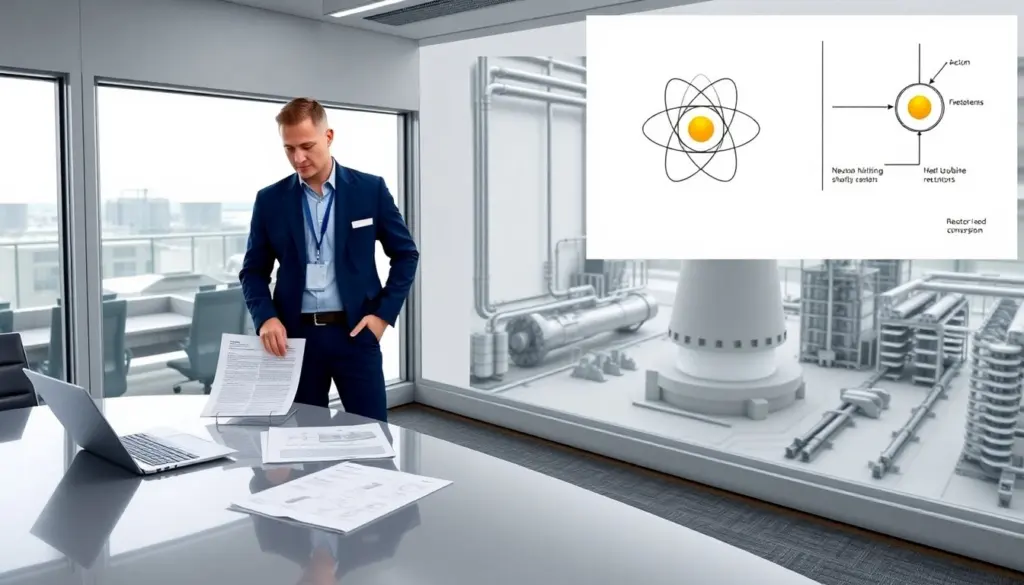
How does nuclear energy work is a common question. This article answers that question with clear facts. It explains atoms, fission, reactors, and electricity. It shows safety steps and new technologies. Readers will get direct, usable answers without fluff.
Key Takeaways
- Nuclear energy works by splitting heavy atomic nuclei through fission, releasing binding energy as heat used to produce electricity.
- Control of the fission chain reaction in reactors is crucial for maintaining steady and safe power output.
- Fuel rods enriched with uranium-235 are used in reactors to sustain fission, with spent fuel carefully replaced and managed.
- Nuclear power plants convert heat from fission into steam that spins turbines generating electricity for the grid.
- Safety measures include multiple barriers, emergency cooling systems, and strict waste management to minimize environmental impact.
- Advanced nuclear technologies like small modular reactors and molten salt reactors aim to improve efficiency, safety, and reduce waste.
The Basics Of Nuclear Physics: Atoms, Isotopes, And Binding Energy
Atoms contain protons, neutrons, and electrons. Neutrons and protons sit in the nucleus. Isotopes differ by neutron count. Uranium-235 and uranium-238 are common isotopes. Binding energy holds the nucleus together. Large nuclei hold more binding energy per nucleon change than small nuclei. When a nucleus splits, it releases energy. That release powers reactors. How does nuclear energy work depends on this release of binding energy. Engineers measure energy in joules and electronvolts. They design systems to capture that energy as heat.
To expand on those basics: the balance of forces in the nucleus determines stability. In heavy elements, adding or removing neutrons shifts that balance and can make a nucleus prone to fission when perturbed. The probability that an incoming neutron will cause fission varies with both the neutron’s energy and the target isotope. Reactor designers take these probabilities into account when selecting fuel and moderator materials to ensure a reliable chain reaction.
Understanding binding energy also explains why both fission and fusion can release large amounts of energy — fission moves very heavy nuclei toward more stable, lighter products, while fusion joins very light nuclei to form more tightly bound products. Both processes are manifestations of the same underlying nuclear physics, and practical power systems exploit whichever process is controllable and economical for the technology involved.
Nuclear Fission: The Chain Reaction That Generates Heat
Fission splits a heavy nucleus into lighter nuclei. A neutron hits a nucleus and the nucleus splits. The split releases energy and more neutrons. Those neutrons hit other nuclei and sustain the chain reaction. Operators control the reaction rate to match power needs. Control maintains steady heat output. If operators remove neutrons quickly, the reaction slows or stops. If operators allow neutrons to multiply, the reaction intensifies. That control keeps the plant safe and predictable.
There are several engineered layers of control beyond simply adding or removing neutrons. Control rods made of neutron-absorbing materials are inserted or withdrawn to change reactivity on short timescales. The geometry of the core, coolant temperature, and moderator density also influence neutron behavior and provide passive or automatic feedback that helps stabilize the chain reaction. Modern reactor designs include both active control systems and inherent physical characteristics that reduce the chance of runaway reactions.
Operators and engineers monitor neutron flux, temperature, and other indicators continuously. Reactor protection systems will automatically scram (rapidly insert control rods) if parameters exceed safe limits. Training, redundancy, and strict procedural controls are used to manage human interaction with the system, because predictable, gradual adjustments are safer than abrupt changes.
Fuel Types, Enrichment, And How Reactors Use Uranium
Natural uranium contains mostly uranium-238 and small uranium-235. Reactors need higher uranium-235 concentration than natural ore. Facilities enrich uranium to raise the uranium-235 fraction. Light-water reactors use fuel enriched to about 3–5% uranium-235. Heavy-water and some advanced reactors can use lower enrichment. Fuel is formed into pellets and placed in metal rods. Operators insert fuel rods into the reactor core to start fission. The core yields heat as fission proceeds. Plants replace spent fuel after its efficiency falls.
Beyond uranium, some reactor concepts use mixed oxide fuels that blend plutonium with uranium, or fuels based on thorium. Fast reactors operate without a moderator and can fission a broader range of isotopes, potentially extracting more usable energy from mined material. Fuel fabrication, handling, shipment, and storage follow strict protocols to control radiation exposure, criticality risk, and proliferation concerns; these logistics are a significant part of the nuclear fuel cycle.
From Heat To Electricity: How A Nuclear Power Plant Operates
The reactor core generates heat from fission. Cooling fluid removes heat from the core. The plant uses that heat to boil water into steam. Steam turns turbines. The turbines spin generators. Generators produce electricity for the grid. Condensers cool steam back into water. Pumps return water to the reactor or steam generator. Operators monitor temperature, pressure, and flow constantly. Control rooms adjust valves and control rods to match grid demand. The plant ties into the transmission network to deliver power.
Different reactor types route heat in different ways. In pressurized water reactors, coolant circulates under pressure and transfers heat to a secondary loop to produce steam, keeping radioactive water separate from the turbine and condenser. In boiling water reactors, the water boils directly in the reactor core and steam drives the turbine directly; additional filtration and shielding prevent contamination of turbine components. Some advanced designs use gas or liquid-metal coolants to achieve higher temperatures or lower pressures, which can improve thermal efficiency or enable process heat applications beyond electricity generation.
Operational considerations also include maintenance schedules, outage planning for fuel changes and inspections, and grid integration. Nuclear plants can provide steady baseload power and, depending on design and operational choices, can perform load-following to help balance variable renewable generation. Coordination with grid operators ensures that supply matches demand while maintaining system stability and frequency.
Safety, Waste, And Environmental Considerations
Regulators require multiple safety barriers. Barriers include fuel cladding, the reactor vessel, and containment buildings. Emergency systems provide backup power and cooling. Operators conduct regular drills and maintenance. Nuclear plants emit very low greenhouse gases during operation. They produce radioactive waste that requires careful handling. Operators store spent fuel in pools then in dry casks on site or at licensed facilities. Waste contains long-lived isotopes that need isolation. Governments set standards for transport and disposal. They monitor air, water, and soil around plants to detect leaks.
Safety culture and regulatory oversight are central to minimizing risk. Licensing processes require demonstration of design robustness, emergency planning, and environmental impact assessments. International bodies and national regulators share best practices, conduct inspections, and require transparent reporting. Lessons learned from past incidents have driven upgrades in design, training, instrumentation, and emergency response planning.
Radioactive waste management covers several categories, from short-lived, low-activity materials to high-level waste that remains hazardous for long periods. Interim storage solutions and research into long-term disposal options, including engineered geological repositories, are part of national programs. Decommissioning a plant at the end of its life involves dismantling systems, decontaminating structures, and managing remaining radioactive materials to protect people and the environment.
Advanced And Alternative Nuclear Technologies To Watch
Small modular reactors use factory-built modules to lower costs and speed deployment. Molten salt reactors dissolve fuel in a hot liquid and can operate at low pressure. Fast reactors reuse some waste and extract more energy from fuel. Fusion research tries to join light nuclei to release energy like the sun. Each technology aims to improve safety, reduce waste, or lower cost. Companies test designs and regulators review them for approval. Pilots and prototypes will show which designs scale best. Investors and utilities track progress closely.
When considering how does nuclear energy work in these emerging systems, focus on the engineering differences: coolant choice affects operating pressure and heat transfer; fuel form changes refueling and waste characteristics; and passive safety features can reduce dependence on active systems and operator actions. Demonstrations and pilot projects are crucial steps that validate performance, reveal engineering challenges, and inform regulatory frameworks before wider deployment.
Research priorities include improving fuel cycles to minimize long-lived waste, enhancing materials that tolerate high temperatures and radiation, and refining manufacturing methods to reduce costs. Policy, finance, public acceptance, and supply chain development will shape which advanced technologies move from prototype to commercial use. For readers asking how does nuclear energy work now and in the future, the physics is constant, but the engineering, economics, and governance will determine practical outcomes.
How does nuclear energy work in these new systems follows the same physics. They all rely on nuclear reactions to release binding energy. They differ in fuel form, coolant, and safety systems. Those differences affect cost, waste, and siting choices.