
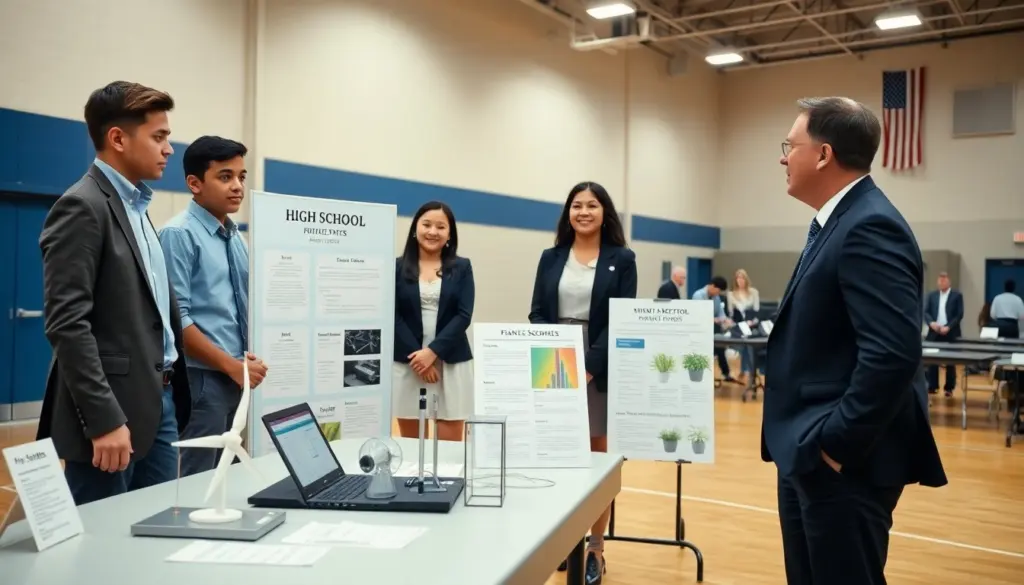
High school science fair projects often decide grades and scholarships. This guide lists practical project ideas and clear advice. It helps students pick a project that matches their skills and resources. It shows how to form a testable question, run experiments, and present results. The guidance aims to increase the chance of a high score at a fair in 2026. Use this as a practical checklist you can adapt to school rules, available lab time, and your personal interests so your high school science fair projects are feasible, safe, and compelling.
Key Takeaways
- Choosing the right high school science fair project involves matching your interests, available time, budget, and safety considerations with a clear, testable question.
- High school science fair projects in biology, physics, and computer science should emphasize controlled variables and measurable outcomes for reliable results.
- Follow a step-by-step process: form a hypothesis, identify variables, conduct multiple trials, record data accurately, and use basic statistics to analyze results.
- Effective presentation is key—use clear headings, concise text, and practiced summaries to communicate your high school science fair project confidently to judges.
- Preparing for judges’ questions and arriving early to set up can boost your confidence and improve your science fair project’s score.
How To Choose The Right Science Fair Project For You
Students should match a high school science fair project to their interest and time. They should list topics they enjoy and rank available hours. They should check available equipment and budget. They should confirm safety and ethical rules with a teacher. They should form a clear question that allows measurement. They should prefer projects with repeatable tests and measurable outcomes. They should pick a project that they can explain simply to a judge.
To refine choices, create a short feasibility matrix: columns for complexity, cost, time, and safety; rows for top 3 project ideas. Assign simple scores (low/medium/high) and choose the best balance. Consider access to mentors or lab space—projects requiring specialized equipment may be possible if a local college or community lab is willing to help. If you have limited time, prefer projects that can be completed in staged milestones (pilot test → main trials → analysis) so you can demonstrate progress at interim checkpoints.
Also think about the scientific question. Good high school science fair projects answer a single, focused question (for example: “How does light spectrum affect radish seed germination rate?” rather than “Do lights affect plants?”). A narrower question is easier to design controlled trials for and yields clearer graphs and conclusions, which judges appreciate.
High-Potential Project Ideas
Biology & Environmental Projects
Students can test plant growth under different light spectra. They can measure bacterial growth with household disinfectants. They can study microplastic filtration in local water. They can compare compost methods and measure nutrient retention. They can analyze soil pH effects on seed germination. Each high school science fair project here shows clear variables and measurable endpoints.
When planning biology projects, emphasize safe handling and appropriate controls: include sterile technique where needed, clearly label trial groups, and document permits for environmental sampling. For example, for plant light experiments, control for soil type, watering schedule, and temperature so the independent variable is only light spectrum. Record growth by height, leaf count, or dry biomass for reproducible outcomes.
Physics & Engineering Projects
Students can build and test model wind turbines for power output. They can design a bridge and measure load capacity. They can test heat transfer in different insulation materials. They can create a simple spectrometer and measure light wavelengths. They can measure smartphone sensor accuracy under controlled conditions. Each project emphasizes controlled variables and repeatable measurement.
Design projects benefit from clear success criteria and repeat trials. For a bridge build, document material types, joint methods, and span length; test load incrementally and photograph the failure mode. For wind turbine experiments, use the same fan speed and distance for each trial and measure voltage/current with consistent instrumentation. Include diagrams and CAD sketches on your display to show engineering thought process.
Computer Science & Math Projects
Students can train a small machine learning model to classify plant leaves. They can analyze traffic patterns using public data and simple models. They can test encryption algorithms for speed and accuracy. They can run a simulation to compare epidemic spread under different rules. They can measure algorithm efficiency on sorting tasks. Each high school science fair project here pairs code with clear evaluation metrics.
For CS projects, emphasize reproducibility: provide pseudocode or flowcharts, describe training and test data sources, and state hardware used. Include confusion matrices, ROC curves, or time complexity plots where appropriate. If working with data from external sources, document how it was obtained and any preprocessing steps to maintain transparency for judges.
Step‑By‑Step Execution Guide: From Hypothesis To Results
Form a concise hypothesis for the chosen high school science fair project. Identify the independent, dependent, and control variables. Create a materials list and a simple protocol with numbered steps. Run at least three trials for each condition and record raw data in a table. Use basic statistics such as mean and standard deviation to summarize results. Draw clear graphs that match the data type. Check for errors and repeat tests if results vary widely. State whether results support the hypothesis and explain possible reasons.
Break the work into a timeline with milestones: literature review and planning (week 1–2), pilot tests (week 3), main trials (weeks 4–6), analysis and repeats (weeks 7–8), and presentation preparation (weeks 9–10). Keep a lab notebook or digital log with timestamps, photos, and notes about anomalies—judges often look for rigor in record keeping. For experiments, randomize sample order when possible to reduce bias and include blank or negative controls for comparison.
On analysis: choose plots that make trends obvious—scatter plots with trend lines for continuous data, bar charts with error bars for categorical comparisons. If you use statistical tests (t-test, ANOVA), state assumptions and significance thresholds you used. If results are inconclusive, describe logical next steps and what modifications would make the experiment more decisive; this demonstrates scientific thinking even when outcomes aren’t definitive.
Presentation And Judging Tips To Maximize Your Score
Prepare a display that shows the high school science fair project question, method, and results in that order. Use large headings and clear figures. Keep text short and precise. Practice a one-minute summary that states the question, the main result, and the implication. Practice a five-minute explanation that covers method, data, and limits. Anticipate common judge questions and prepare brief answers. Bring printed raw data and any permits. Dress neatly and arrive early to set up. Speak calmly and let the data drive the discussion.
Organize your poster or tri-fold with a visual flow: left column for background and hypothesis, center for methods and key photos/diagrams, right for results, conclusions, and next steps. Use bullet points rather than dense paragraphs and include labeled figures with captions. Have a printed one-page abstract to hand to judges and a backup digital copy on a tablet for interactive demos. If your project involves live demonstrations or instruments, rehearse setup to avoid delays and bring spare batteries, extension cords, and basic tools.
Practice common judge interactions: brief elevator pitch (30–60 seconds), guided tour (3–5 minutes), and deep dive (10+ minutes answering technical questions). Prepare to explain limitations and ethical considerations candidly—doing so shows maturity. After the judging, take notes on questions asked and feedback received; this will help for future fairs or when revising the project for higher-level competitions.