
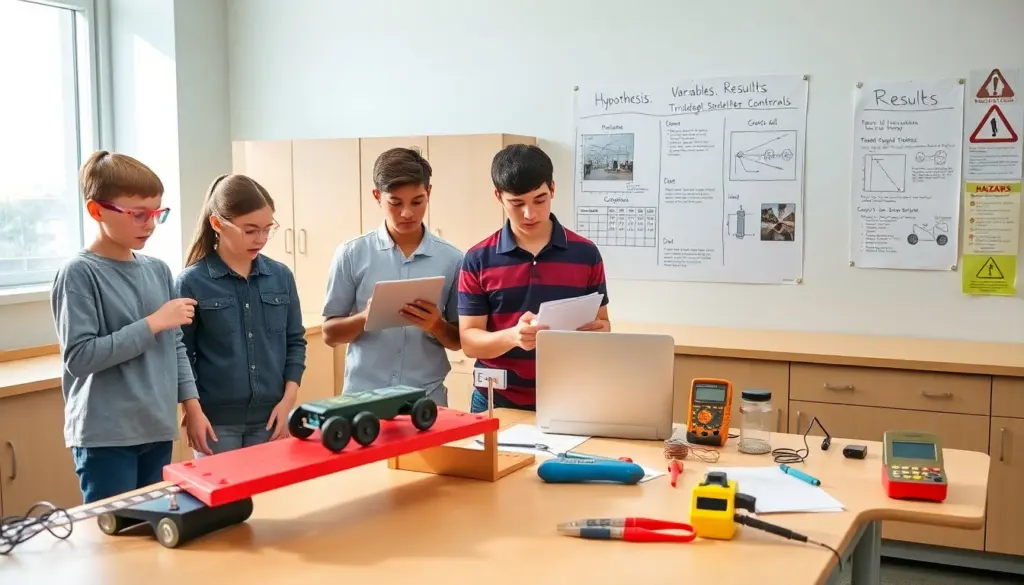
Physics science fair projects help students learn methods and record results. This guide lists clear project options, shows simple steps, and points out common mistakes. It helps students pick a project that fits their grade, time, and materials. The advice stays practical. Teachers and parents can use it to support experiments and to check safety and procedure.
Key Takeaways
- Physics science fair projects teach students how to formulate hypotheses, control variables, and analyze measurable changes effectively.
- Choosing a physics project appropriate to grade level and available time ensures manageable and successful experiments.
- Beginner-friendly projects, like testing friction or wave speed, use simple materials and demonstrate clear physics principles.
- Accurate data collection and analysis, including repeated trials and graphing results, are crucial for reliable conclusions.
- Avoid common mistakes by calibrating instruments, maintaining consistent methods, and explicitly controlling variables.
- Safety precautions and clear reporting, including stating the hypothesis and interpreting data honestly, are essential for a quality physics science fair project.
How To Choose The Right Physics Project For Your Grade And Timeframe
Students should match a physics science fair project to their skills and schedule. A middle school student should pick simple measurement tasks. A high school student can pick a project with deeper analysis. They should list available time, materials, and supervision. They should choose a topic that uses clear variables. Projects that take longer than the available time should be avoided. Students should pick projects that show measurable change. If a project needs special equipment, they should confirm access before they start.
Six Beginner-Friendly Physics Project Ideas (Grouped With Expected Results)
These six physics science fair projects use low-cost materials and offer clear outcomes. Each idea states the core question, the expected result, and one tip for success.
Mechanics Experiments (Push, Pull, Friction, 2 Projects)
- Ramp friction test. Question: How does surface texture affect friction? Expected result: Rougher surfaces increase friction and slow the object. Tip: Use consistent mass and incline angle.
- Elastic collision model. Question: How does mass affect rebound speed? Expected result: Lighter object gains more speed after collision. Tip: Use a motion sensor or slow-motion video for accurate timing.
Waves And Sound Experiments (2 Projects)
- String wave speed. Question: How does tension affect wave speed? Expected result: Higher tension gives faster wave speed. Tip: Measure distance and time precisely.
- Resonance in cups. Question: How does water depth change pitch? Expected result: More water lowers pitch. Tip: Mark water levels and use a tuner app for frequency readings.
Electricity And Magnetism Experiments (2 Projects)
- Simple circuit resistance. Question: How does wire length affect current? Expected result: Longer wire lowers current. Tip: Keep voltage stable and note wire gauge.
- Electromagnet strength. Question: How do coil turns affect lift? Expected result: More turns increase magnetic force up to a limit. Tip: Use the same core and measure lift with standard weight increments.
Designing A Clear, Testable Experiment: Hypothesis, Variables, And Controls
A good physics science fair project starts with a clear hypothesis. The hypothesis should state the expected direction of change. Students should list one independent variable and one dependent variable. They should keep other factors constant as control variables. They should design at least three trial runs for each condition. They should randomize order to reduce bias. They should record units and measurement methods. They should include a control group when possible. They should justify why the test will show a causal effect.
Collecting Data, Analyzing Results, And Avoiding Common Errors
Students should plan a data table before they test. They should record raw numbers and units for every trial. They should compute averages and standard deviation when possible. They should plot data on graphs with labeled axes and units. They should use linear fits or simple curves to test trends. They should check for outliers and explain them rather than delete them without reason.
Common errors appear in measurement, bias, and safety. Students often measure inconsistently. They should use the same tool and method for each trial. They often change one variable unintentionally. They should list every control explicitly. They sometimes misread instruments. They should calibrate tools first. They sometimes draw broad conclusions from small samples. They should limit claims to what the data supports.
Students should plan simple safety steps. They should use goggles for experiments with heat, glass, or electricity. They should disconnect power before changes. They should get adult help for tools and soldering. They should label hazards on the project display.
When students prepare the final report, they should state the hypothesis, describe methods, show data, and interpret results. They should explain uncertainty and suggest one clear follow-up test. They should avoid vague claims and stick to what the data shows.