
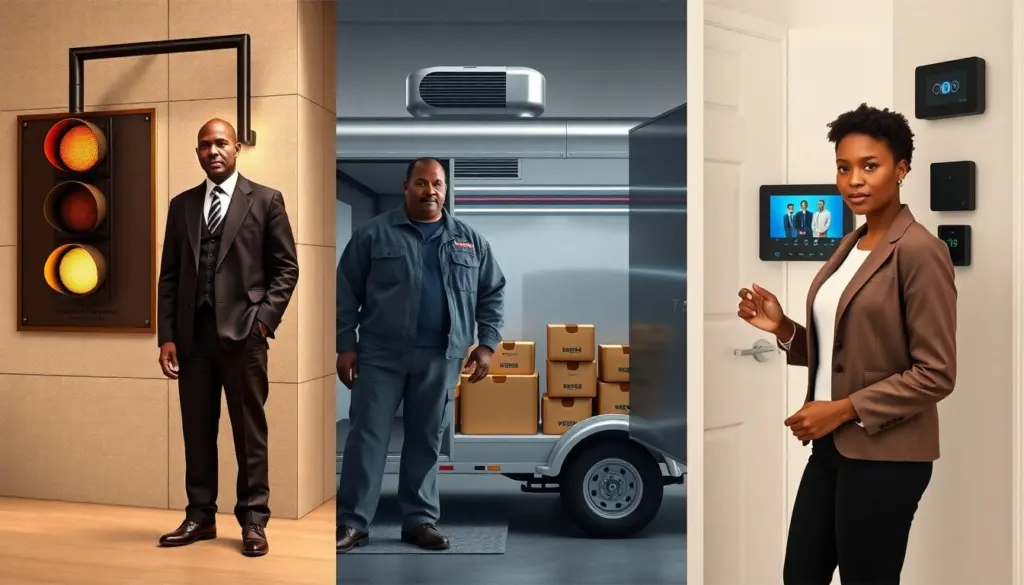
Black inventions that changed the world appear across everyday life. This article lists three inventions and explains how they changed safety, food transport, and home security. The writing stays clear and direct. Each section names the inventor, describes the invention, and shows its impact on society.
Key Takeaways
- Garrett Morgan’s invention of the three-position traffic signal introduced a warning phase that significantly improved road safety and influenced modern traffic light designs.
- Frederick McKinley Jones revolutionized food and medicine transport with his mobile refrigeration system for trucks, enabling longer-distance cold storage and reducing spoilage.
- Marie Van Brittan Brown’s home security system pioneered remote monitoring and control, laying the foundation for today’s CCTV and smart lock technologies.
- These black inventions addressed real-world problems, improving public safety, food distribution, and home security on a lasting scale.
- Understanding and recognizing these black inventions highlights their vital role in shaping everyday safety, convenience, and technology.
Garrett Morgan’s Three-Position Traffic Signal: Safer Streets For Cities
Garrett Morgan invented a three-position traffic signal in 1923. He filed a patent for a signal that added a warning interval between stop and go. The device used a third position to halt traffic while signals changed. Cities adopted the idea because it reduced collisions at intersections. Police departments and city engineers tested his signal. They found that drivers reacted more calmly when they saw a warning phase first.
Morgan’s invention influenced modern traffic lights. The three-position concept forms the basis for today’s yellow light. Traffic engineers integrated the warning interval into automatic controllers. Municipalities used the patent and later refined the timing for different road types. The design improved safety where roads met and where visibility dropped.
Morgan also demonstrated his signal in Cleveland and nearby towns. Local newspapers covered his work. City officials credited the device for clearer traffic flow and fewer crashes. The technology spread because it solved a simple problem with a clear fix. Garrett Morgan’s traffic signal changed how cities organized vehicle movement. It gave drivers a predictable pause and saved lives.
Frederick McKinley Jones’s Mobile Refrigeration: Revolutionizing Food And Medicine Transport
Frederick McKinley Jones invented mobile refrigeration for trucks in 1938. He developed a compact cooling unit that did not need ice. Jones built a system that used a gasoline engine to run a compressor. Truck operators could load perishable goods and maintain low temperatures over long distances. The system let meat, dairy, and produce travel farther without spoilage.
Jones refined the cooling design and the thermostat control. He focused on reliability so drivers could trust the unit on long routes. The refrigeration unit entered commercial use in the 1940s. Cold transport expanded the national food market. Cities received fresher produce and smaller towns accessed new foods. Hospitals benefited when they could ship vaccines and blood plasma safely.
Jones founded a company to manufacture his units and licensed the design to major truck makers. The mobile refrigeration idea reduced waste and lowered food prices. It also helped the military move perishable supplies during wartime. The technology set standards for modern refrigerated trailers. Frederick McKinley Jones’s invention made long-distance cold transport practical and dependable.
Marie Van Brittan Brown’s Home Security System: The Foundation Of Modern Surveillance And Smart Locks
Marie Van Brittan Brown invented a home security system in 1966. She designed a camera, peephole, and a remote monitor. The system used television cameras to show visitors without opening the door. Brown added a microphone and a door release button. A homeowner could see and speak to a visitor and unlock the door from inside.
Her design aimed to increase safety in neighborhoods with poor police response times. She documented how the system let a single person manage access to her home. Brown built a prototype using available consumer electronics. She filed for a patent and later received it in 1969. The system included motion sensors and a button to alert security personnel.
Marie Van Brittan Brown’s ideas shaped later CCTV and smart lock systems. Manufacturers adapted the camera-and-monitor model for apartment buildings and stores. Modern smart locks use the same principle of remote door control and visual verification. Homeowners now use mobile apps that mirror Brown’s original function: view a visitor, talk, and grant entry without opening the door. Her invention led to broader adoption of electronic security for private homes and public spaces.