
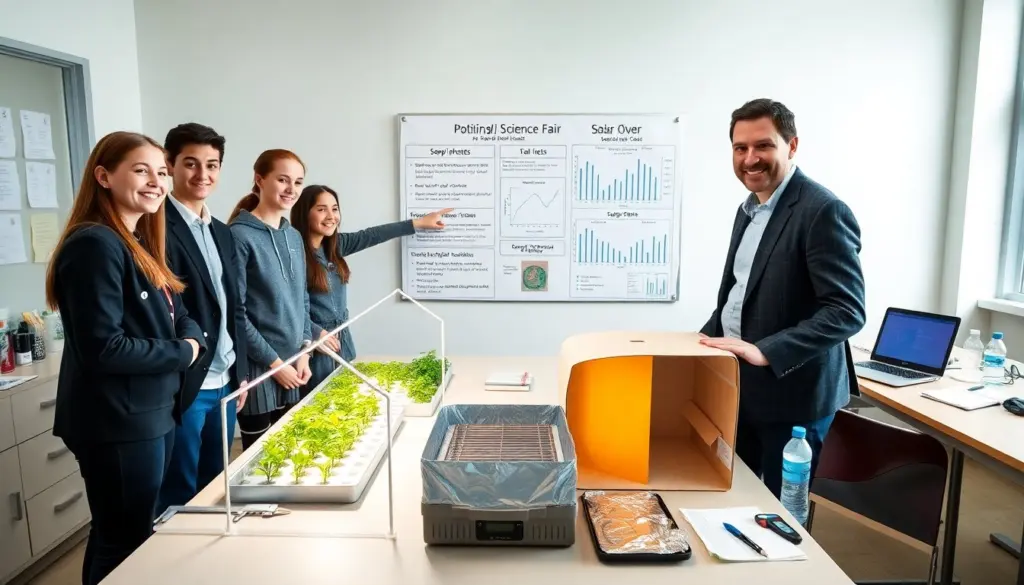
Students read this guide to find 8th grade science fair project ideas that match skill and time. The guide lists safe experiments, clear hypotheses, and simple procedures. Teachers and parents use the ideas to plan support and supplies. Projects focus on measurable results, repeatable steps, and low cost equipment.
Key Takeaways
- Choosing 8th grade science fair project ideas involves matching your interest, skill level, and available time for best results.
- Focus on projects with clear hypotheses, measurable data, and simple procedures to ensure safety and feasibility.
- Biology projects are popular and effective when using safe organisms, clear variables, and well-documented measurements.
- Physical science and engineering projects work well by testing measurable changes like temperature, speed, or strength with repeatable methods.
- Planning your experiment carefully, using controls, repeating trials, and recording detailed data are crucial to avoid common mistakes and achieve reliable results.
How To Choose The Right Project For Your Grade Level And Goals
Students choose 8th grade science fair project ideas by matching interest, skill, and time. First, they pick a topic that keeps them curious. Second, they check safety rules and teacher limits. Third, they set a clear question and hypothesis that a single experiment can test. Fourth, they list needed materials and estimate cost and time. Finally, they pick projects that allow measurable data, like counts, times, or temperatures. Teachers advise keeping scope small so the student can finish and analyze results well.
Biology Project Ideas That Are Safe And Scientific
Biology projects remain popular for 8th grade science fair project ideas because they use visible changes and clear measurements. Students choose experiments that use safe organisms or nonliving models. They follow simple sterilization and control rules. Records should include dates, photos, and measured values. Students explain results with basic biology terms and cite sources. The next two subtopics show specific ideas with variables, controls, and measurement plans.
Effect Of Light Color On Plant Growth (Variables, Procedure, What To Measure)
Question: Does light color affect plant growth? Hypothesis: Plants under blue light will grow taller than plants under red light. Variables: Independent variable is light color. Dependent variables are height, leaf count, and fresh mass. Controls: Use same soil, pot size, water schedule, and plant species. Procedure: Plant identical seedlings in separate pots. Expose each group to a different LED light color eight hours per day. Measure seedling height and leaf count every three days for four weeks. At the end, measure fresh mass and record photos. Analysis: Compare averages and use simple bar charts. Discuss possible reasons using photosynthesis basics.
Comparing Microbial Growth On Common Household Surfaces (Sampling And Controls)
Question: Which household surface shows the most microbial growth? Hypothesis: Kitchen sponge will show more colonies than a door handle. Safety: Use safe culturing methods with teacher approval and avoid pathogens. Materials: Sterile swabs, nutrient agar plates, marker, incubator or warm area. Procedure: Swab equal surface areas of each item. Streak plates using defined patterns. Incubate plates for 48–72 hours at recommended temperature. Controls: Use a sterile swab and a blank plate to check contamination. Measurement: Count colony forming units per plate and photograph results. Analysis: Report average counts and discuss cleaning methods and hygiene implications.
Physical Science And Engineering Ideas With Clear Hypotheses
Physical science projects make solid 8th grade science fair project ideas because they allow precise measurement and repeat tests. Students form hypotheses that predict measurable change, like distance, speed, temperature, or lift. Projects can test material strength, simple circuits, or aerodynamics. Students write stepwise methods, record repeated trials, and show calculations. Results should include tables, graphs, and error discussion. The next subtopic gives one engineering example with a clear measurement plan.
Build A Simple Solar Oven And Measure Temperature And Cooking Efficiency
Question: How does reflector angle affect solar oven temperature? Hypothesis: A wider reflector angle will raise oven temperature. Materials: Cardboard box, aluminum foil, black tray, thermometer, protractor, food item like s’more. Procedure: Line box and reflectors with foil. Place a thermometer inside and set reflectors at a chosen angle. Record internal temperature every ten minutes for an hour under direct sun. Repeat trials with different reflector angles. Measurement: Track peak temperature, time to reach 60°C, and whether the food cooks. Analysis: Compare temperatures across angles using graphs and calculate efficiency as temperature rise per minute. Discuss how insulation and sun angle affect results.
Planning Your Experiment, Collecting Data, And Avoiding Common Mistakes
Students plan experiments with clear steps and a timeline. They write a testable question, a measurable hypothesis, and a list of variables. They use controls and repeat trials at least three times. For data, they record raw numbers, dates, and conditions in a lab notebook. They use tables and simple graphs to show trends. Common mistakes include changing multiple variables, using small sample sizes, and skipping controls. To avoid errors, students pilot the method once, check instruments, and keep photos. Teachers check safety and data methods before final trials.